Stainless Steel Bars for New Energy Vehicles: Motor Shafts, Connectors and Precision Parts
Review stainless steel bars for NEV and EV parts, including motor shaft stock, connectors, fasteners, sensor housings, 304, 316L, 303 and ground bar sourcing.
In This Guide
- Introduction
- Key Applications of Stainless Steel Bars in NEV and EV Parts
- Grade Selection Table for EV Stainless Steel Bar Parts
- 304 Stainless Steel Bar for General EV Parts
- 316L Stainless Steel Bar for Corrosion-Sensitive EV Parts
- 303 Stainless Steel Bar for CNC EV Components
- Stainless Steel vs Aluminum: A Practical EV Buyer View
- Machining, Tolerance and Surface Finish Matter
- Fasteners and Standard Review
- Sustainability and Material Traceability
- Quote Checklist for EV Stainless Steel Bar Parts
- Southeast Asia EV Parts Sourcing Fit
- Standards and Reference Notes
Introduction
New Energy Vehicles and electric vehicles are changing how buyers review metal parts.
The material decision is no longer only about light weight. EV and NEV projects also need safety, corrosion resistance, dimensional stability, machining consistency and traceable documents.
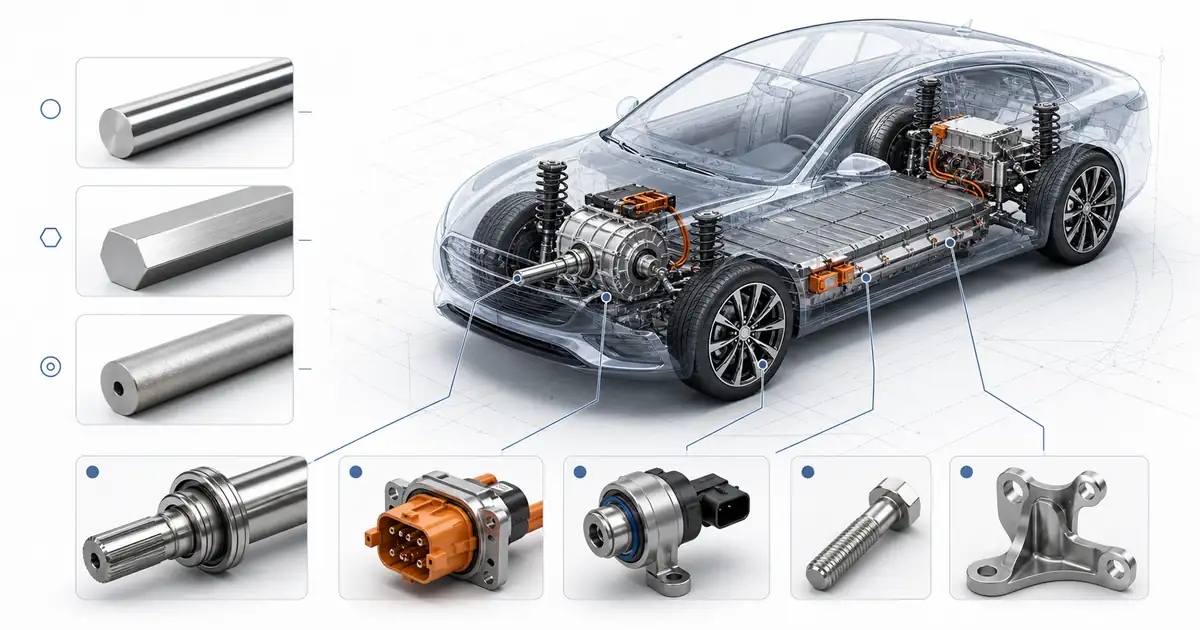
For many precision parts, stainless steel bars for NEV are a practical sourcing route. An electric vehicle stainless steel bar inquiry may involve round bar, hex bar or centerless ground bar that will be machined into connectors, fasteners, sensor housings, support pins, brackets and selected shaft components.
This guide keeps the focus on bar stock and machined parts. It is not a general battery pack material article. It is written for Southeast Asia CNC workshops, EV component buyers and sourcing teams who need a clearer way to specify stainless steel bar before quotation.
Key Applications of Stainless Steel Bars in NEV and EV Parts
Stainless steel bar is useful when the final part needs strength, corrosion resistance, thread durability, dimensional control or a stable machining route.
Common EV-related bar applications include:
- high-voltage connector bodies and support parts
- fasteners, pins, bushings and spacers
- sensor housings for temperature or pressure monitoring
- machined brackets and support blocks
- selected motor shaft or transmission-related components
- battery management system support parts
- corrosion-resistant fittings and mounting parts
The exact grade still depends on the drawing, mechanical requirement, environment and certification needs.
Grade Selection Table for EV Stainless Steel Bar Parts
The table below is a first review, not a replacement for the drawing or project standard.
| Grade / Family | Typical EV Part Review | Main Benefit | Buyer Check |
|---|---|---|---|
| 304 / 304L | General connectors, brackets, fittings, housings and support parts | Balanced corrosion resistance, availability and fabrication route | Confirm standard, MTC, tolerance and whether 304L is required |
| 316 / 316L | Corrosion-sensitive parts, coastal delivery environments, chemical or coolant exposure areas | Better chloride and corrosion resistance than 304 | Confirm Mo content, MTC, surface finish and exposure condition |
| 303 | CNC-turned connector parts, pins and repeat machined components | Better machinability and chip control than 304 in many jobs | Confirm sulfur, heat number, corrosion requirement and final environment |
| 430 / 400 series | Selected magnetic or shaft-related requirements when specified | Magnetic behavior and grade-specific mechanical properties | Confirm whether the project actually requires 400 series |
| Duplex stainless | Higher-strength corrosion-resistant parts when specified | Strength and corrosion performance in selected demanding environments | Confirm availability, standard, heat treatment and lead time |
For daily sourcing, 304, 316L and 303 are usually the first grades to review because they connect more directly with common stainless steel bar stock routes.
304 Stainless Steel Bar for General EV Parts
304 stainless steel bar EV parts are often reviewed when the buyer needs a general-purpose corrosion-resistant material with broad availability.
304 round bar or square bar can be used for brackets, fittings, housings and support parts where extreme corrosion resistance is not the main requirement. 304L may be reviewed when welding or low-carbon requirements matter.
For sourcing, buyers should confirm ASTM or project standard wording before purchase. ASTM A276/A276M covers stainless steel bars and shapes, including hot-finished and cold-finished bar forms such as rounds, squares and hexagons.
If your project needs a common stock route, review our 304/304L stainless steel bar page.
316L Stainless Steel Bar for Corrosion-Sensitive EV Parts
Some EV parts face road moisture, coastal shipment conditions, chloride exposure, coolant contact or chemical cleaning.
In these situations, 316 stainless steel bar corrosion resistant vehicle parts may be a better review path than 304. The molybdenum content in 316/316L supports improved corrosion resistance in many chloride-related environments.
316L is not automatically needed for every EV part. It should be selected when the application environment justifies the added cost and machining review.
For parts exposed to harsher environments, see our 316/316L stainless steel bar page.
303 Stainless Steel Bar for CNC EV Components
Many EV parts are not large structural pieces. They are small precision components that need stable CNC turning.
303 stainless steel bar can be useful for connector bodies, pins, spacers, fittings and repeat turned parts where machinability is important. Added sulfur supports chip breaking and can make repeated CNC cutting more stable than 304 in suitable jobs.
303 is not the right choice when maximum corrosion resistance is the priority. Buyers should confirm the final environment before using it in an EV-related assembly.
For CNC-focused sourcing, compare our 303 stainless steel bar page and our guide on 303 vs 304 stainless steel machinability.
Stainless Steel vs Aluminum: A Practical EV Buyer View
Aluminum is important for EV lightweighting. It is not the enemy of stainless steel.
The practical question is where each material fits best.
Stainless steel is often reviewed when the part needs:
- corrosion resistance without relying only on coating
- higher thread strength or wear resistance
- stable fastener performance
- heat resistance in selected areas
- surface durability after machining
- document traceability by heat number and MTC
Aluminum is often reviewed when weight reduction is the main priority. Stainless steel is reviewed when safety margin, corrosion control, strength, maintenance risk or precision machining behavior matter more.
This is why many EV supply chains use both materials in different positions.
Machining, Tolerance and Surface Finish Matter
For EV precision parts, the grade name alone is not enough.
A buyer may ask for 304 stainless steel bar, but the final result depends on diameter tolerance, straightness, finish, heat number and whether the material route fits the machining process.
Key bar requirements include:
- diameter or across-flats size
- h9 / h10 / h11 or drawing tolerance
- cold drawn, peeled, polished or centerless ground finish
- straightness requirement for bar feeding
- heat number and MTC matching
- cut length and packing method
For shaft-like parts or tight feeding requirements, centerless ground stainless steel bar may be reviewed because it supports tighter diameter control and smoother surface condition.
For tolerance details, read our h9, h10 and h11 stainless steel bar tolerance chart.
Fasteners and Standard Review
EV assemblies use many fasteners and small connector parts. Stainless steel bar and wire routes may be reviewed depending on the part geometry and manufacturing process.
For stainless steel fasteners, the ISO 3506 series is a useful standard background. ISO 3506-1:2020 covers mechanical and physical properties for corrosion-resistant stainless steel bolts, screws and studs. ISO 3506-6:2020 covers general rules and additional stainless steels and nickel alloys for fasteners.
Buyers should not simply write "EV fastener material" in an inquiry. A useful inquiry should include the part drawing, grade, strength requirement, thread details, corrosion requirement and document needs.
Sustainability and Material Traceability
EV programs often care about sustainability, but sustainability claims should be written carefully.
Stainless steel is widely recyclable, and many international producers discuss its role in lower lifecycle impact. EV material discussions from suppliers such as Outokumpu also highlight how stainless steel can support strength, heat resistance, processability and sustainability in EV-related applications.
For bar buyers, the practical sustainability point is traceability. A clear MTC, heat number and documented grade route help the buyer connect the shipped bar with the finished EV component batch.
Quote Checklist for EV Stainless Steel Bar Parts
A useful EV stainless steel bar inquiry should include:
- grade: 304, 304L, 316, 316L, 303, 430, duplex or another requested grade
- shape: round, hex, square, ground bar or peeled bar
- diameter or across-flats size
- tolerance: h9, h10, h11 or drawing tolerance
- surface finish and straightness requirement
- final application: connector, fastener, sensor housing, shaft, bracket or other part
- quantity: sample, trial order or batch order
- drawing or standard if available
- MTC and heat number requirement
- destination country, city or port
These details help the supplier review a real supply route instead of sending a generic kilogram price.
Southeast Asia EV Parts Sourcing Fit
Vietnam, Thailand, Indonesia and Malaysia are building more automotive, electronics and precision machining capacity.
For these buyers, the challenge is not only finding a stainless steel bar supplier. The challenge is getting a stable combination of grade, size, tolerance, finish, documents and export packing.
FX Stainless Steel can review 303, 304, 316L and other requested stainless steel bar routes for EV-related precision parts. Trial order review, samples, MTC support, cutting and export packing can be discussed based on current stock and the final drawing.
For Southeast Asia EV parts suppliers, a clear bar inquiry can shorten back-and-forth before trial machining. For a practical quote, use our stainless steel bar quote page.
Standards and Reference Notes
This guide uses standards and industry references as sourcing background, not as a substitute for project drawings.
Useful references include ASTM A276/A276M for stainless steel bars and shapes, ISO 3506-1:2020 and ISO 3506-6:2020 for corrosion-resistant stainless steel fastener context, and Outokumpu EV battery module material discussion for EV-related stainless steel material considerations.
Final grade selection should still be confirmed by drawing, standard, MTC and application environment.
Conclusion
Stainless steel bars have a practical role in NEV and EV supply chains. They are not only raw metal. They become connectors, fasteners, sensor housings, support parts and selected precision components.
The right choice depends on grade, machining behavior, corrosion environment, tolerance, finish and traceability.
304 is a strong general-purpose starting point. 316L is reviewed when corrosion risk is higher. 303 is useful when CNC machinability and chip control matter. 400 series and duplex grades may be reviewed for specific project requirements.
The best sourcing result starts with a clear drawing and a complete inquiry.
Frequently Asked Questions (FAQ)
Q. Which stainless steel bar grades are commonly reviewed for NEV and EV parts?
A. 304, 316L and 303 are often reviewed for EV connectors, fasteners, sensor housings and machined support parts. 400 series or duplex grades may be considered for specific shaft or strength requirements.
Q. Is stainless steel always better than aluminum for EV parts?
A. No. Aluminum remains important for lightweight structures. Stainless steel is reviewed when corrosion resistance, strength, heat resistance, thread durability, wear resistance or traceability matter more than minimum weight.
Q. What should buyers check before ordering stainless steel bar for EV precision parts?
A. Buyers should confirm grade, shape, diameter or across-flats size, tolerance, finish, straightness, quantity, drawing requirement, MTC and destination.
Q. Can FX Stainless Steel support trial orders for EV stainless steel bar parts?
A. Yes. Trial order review is available for many 303, 304 and 316L stainless steel bar inquiries depending on grade, size, finish, tolerance and current stock route.
CTA
Send your grade, bar shape, size, tolerance, finish, quantity, drawing and destination. FX Stainless Steel can review the practical route for stainless steel bars for NEV and EV precision parts.