
Why 303 Stainless Steel Bar Machinability Varies: A CNC Manager's Guide to Sulfur and MTC Data
Learn why 303 stainless steel bar machinability varies, how sulfur and MTC data affect CNC cutting, and what Southeast Asia buyers should check before trial orders.
In This Guide
- Introduction
- Quick Answer: Why Sulfur Matters in 303 Bar
- The Science: Sulfur, MnS and Chip Breaking
- 303 Bar MTC Parameter Table
- Common Workshop Symptoms and Material Checks
- Practical Example: Connector Parts in Ho Chi Minh City
- Logistics Note for Vietnam Buyers
- How to Specify 303 Bar for a Trial Order
- Why FX Stainless Steel Fits 303 Bar Sourcing
Introduction
For CNC workshop managers in Vietnam, Thailand and other Southeast Asia machining hubs, a broken drill bit or chipped insert is more than a small tooling cost. It can stop the machine, scrap parts and delay delivery to the customer.
That is why 303 stainless steel bar is popular for repeated turning, connector parts, small shafts, fastener blanks and screw-machine work. But 303 does not perform well just because the label says "303". The real machining behavior depends on chemistry, bar condition and traceability.
The element buyers should pay attention to first is Sulfur (S).
Quick Answer: Why Sulfur Matters in 303 Bar
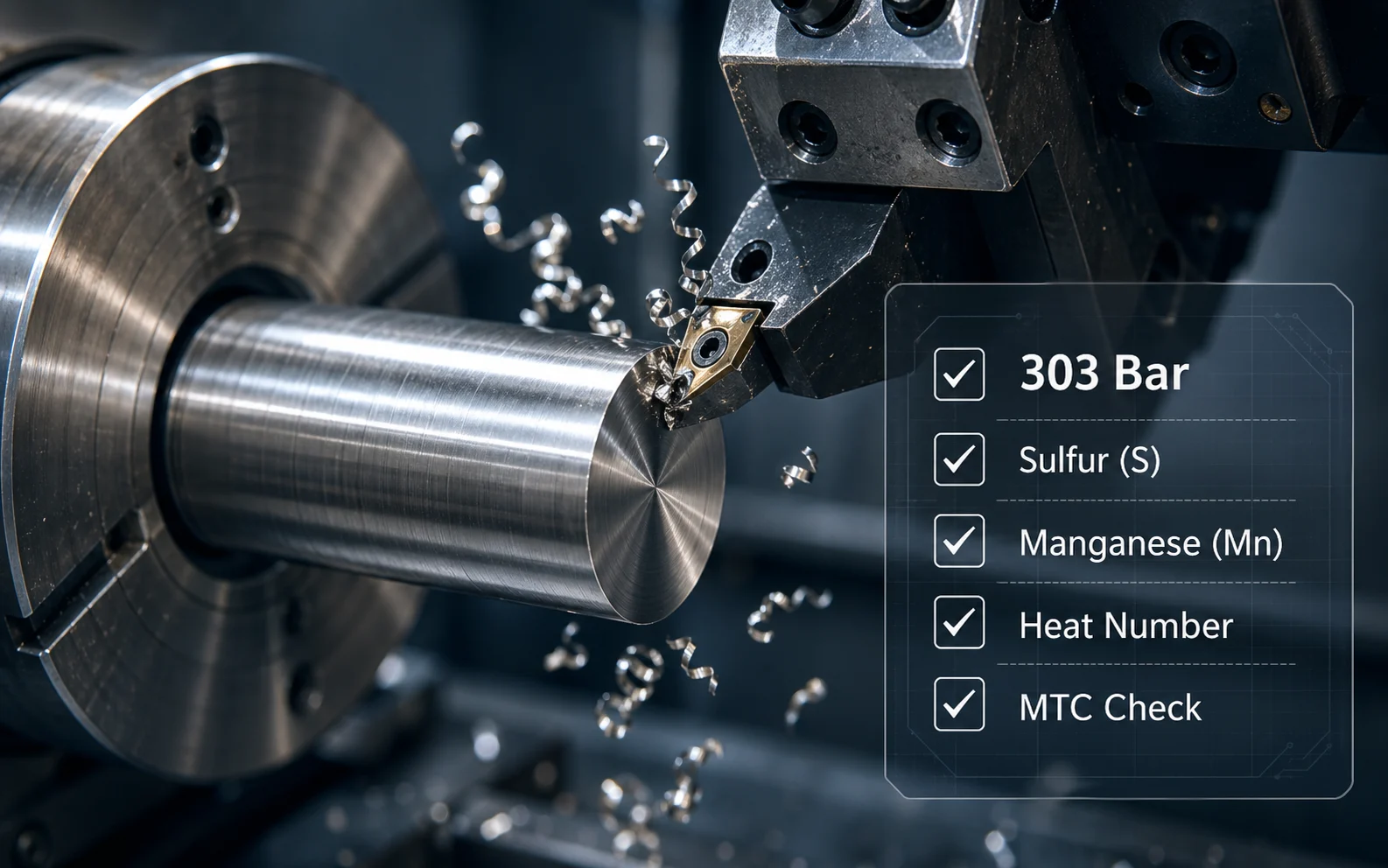
Sulfur content matters in 303 stainless steel bar because sulfur helps form manganese sulfide inclusions. These inclusions support chip breaking and reduce cutting resistance during CNC machining.
When sulfur control is weak, the bar may cut less predictably. The workshop may see long stringy chips, higher cutting load, unstable surface finish or more abnormal tool changes. Sulfur is not the only cause of tool breakage, but it is one of the first items buyers should check on the Mill Test Certificate.
The Science: Sulfur, MnS and Chip Breaking
The main difference between 303 and 304 is not only the name on the drawing. 303 is designed as a free-machining stainless grade. It contains sulfur so that sulfur can combine with manganese and form manganese sulfide (MnS) inclusions.
These inclusions are useful during cutting. They help the chip break more easily instead of forming long, sticky chips. They also reduce the feeling that the material is fighting the tool. For automatic lathes and bar-fed CNC jobs, this matters every shift.
If sulfur is too low for the expected 303 behavior, the material may behave closer to 304: tougher, more gummy and more likely to create work-hardening pressure. If the batch is poorly controlled, different bars may not machine the same way. That is when operators start to blame the tool, the coolant or the machine, while the material record was the first place to check.
303 Bar MTC Parameter Table
Before buying 303 bar for CNC work, ask for the MTC and review a few practical items. The table does not replace the project drawing or standard, but it helps buyers know where to look.
| MTC Item | What Buyers Should Check | Why It Matters in 303 Bar Machining |
|---|---|---|
| Sulfur (S) | Confirm it matches the required 303 standard or buyer specification | Supports chip breaking and free-machining behavior |
| Manganese (Mn) | Review together with sulfur, not alone | Helps form manganese sulfide inclusions |
| Chromium (Cr) | Confirm the stainless grade basis | Supports the corrosion resistance expected from 303 |
| Nickel (Ni) | Check grade stability and material balance | Affects toughness and stainless steel structure |
| Heat Number | Must match bar label, tag or batch record | Confirms traceability of the supplied batch |
| Tolerance | h9 / h10 / h11 or drawing requirement | Affects CNC feeding, fit and repeatability |
Data note: final chemistry, tolerance and acceptance criteria should be checked against the latest drawing, applicable standard and confirmed order document before production.
Common Workshop Symptoms and Material Checks
Tool breakage is not always caused by material. Speed, feed, coolant, tool geometry and clamping all matter. Still, when a workshop changes supplier and machining behavior changes quickly, the bar data deserves a careful look.
| Workshop Symptom | Possible Material-Related Cause | What to Ask the Supplier |
|---|---|---|
| Frequent drill or insert breakage | Poor chip control or unstable machinability | MTC, heat number and cutting trial support |
| Long stringy chips | Bar behaves closer to 304 than expected | Sulfur / Mn balance and 303 grade confirmation |
| Surface marks after turning | Inconsistent cutting behavior or bar surface issue | Finish type, straightness and diameter tolerance |
| Different performance between batches | Mixed heats or weak traceability | Same heat review, batch separation and label control |
A good supplier should not only quote the price. They should help the buyer connect chemistry, tolerance, finish and batch traceability with the real cutting process.
Practical Example: Connector Parts in Ho Chi Minh City
A precision machining workshop in Ho Chi Minh City was producing repeated connector parts from 303 round bar. After switching to a lower-cost supply route, the operators noticed more abnormal tool changes and less predictable surface finish.
The first step was not to blame the machine. The buyer reviewed the MTC, heat number records and bar condition. The issue was not a single dramatic failure. It was a stability problem: the new supply route did not give the workshop enough confidence that each batch would machine the same way.
A small trial batch with clearer MTC traceability, better batch separation and a machining-ready bar finish helped the workshop compare material behavior under its own cutting conditions. The result was more predictable chip behavior and fewer abnormal interruptions during repeated connector machining.
This is the right way to test a new supplier. Do not judge 303 only by price per kilogram. Judge it by machining rhythm, tool changes, surface finish and whether the documents match the bars on the floor.
Logistics Note for Vietnam Buyers
For Vietnam orders, machining performance is only one part of the landed cost. Document planning also matters. If the shipment qualifies, Form E may help support preferential treatment under China-ASEAN trade rules.
We can help buyers review the order description, origin document path, invoice, packing list and MTC details before shipment. This is not an automatic duty promise. The final result still depends on origin compliance, document consistency and customs-side review by the importer or broker.
How to Specify 303 Bar for a Trial Order
If you want a supplier to understand your machining need quickly, do not send only "303 bar price". Send the working conditions that affect the quote and material review.
- Grade: 303 / SUS303 / ASTM or JIS requirement if the drawing states one
- Shape: round bar, hex bar or square bar
- Size: diameter or across-flats size
- Tolerance: h9, h10, h11 or drawing tolerance
- Finish: cold drawn, centerless ground, polished or bright bar
- Cutting process: turning, drilling, threading, automatic screw machining or connector machining
- Quantity: trial quantity and expected repeat volume
- Destination: Vietnam, Thailand, Indonesia, Singapore or other delivery market
For repeat jobs, also ask whether the supplier can support heat number traceability and batch separation. If the job runs well on one heat, the next order should not become a new guessing game.
Why FX Stainless Steel Fits 303 Bar Sourcing
FX Stainless Steel supports 303 stainless steel round bar and 303 hex bar buyers who care about CNC machinability, tolerance review and export documentation. For trial orders, we can help review grade, diameter, tolerance, finish path, MTC data and packing before shipment.
This does not mean every size is always ready from the same heat. Stock condition changes. But it does mean buyers can ask practical questions before ordering: Is the bar suitable for CNC turning? Does the MTC show the expected chemistry? Can the heat number be reviewed? Is h9 or h10 practical for this diameter?
If you are comparing suppliers for machining work, start with our 303 stainless steel bar page. It covers round and hex bar supply, CNC use cases, trial order support and related grade paths.
Conclusion
In the world of 303 stainless steel, stability is profit. Cheap material can become expensive when it causes tool changes, scrap parts and delivery pressure.
Sulfur content, manganese balance, heat number traceability and tolerance control are not small details. They are part of the real cost of CNC machining. A good 303 bar supplier should help you review those details before the first chip is cut.
Frequently Asked Questions (FAQ)
Q. Why does Sulfur (S) improve 303 stainless steel bar machinability?
A. Sulfur helps form manganese sulfide (MnS) inclusions in 303 stainless steel. These inclusions support chip breaking and reduce cutting resistance compared with 304, making 303 more practical for repeated CNC turning and screw-machine work.
Q. Can low sulfur content cause tool breakage when machining 303 bar?
A. Low or poorly controlled sulfur may contribute to poor chip control and higher cutting load. However, tool breakage can also come from cutting speed, feed rate, tool geometry, coolant setup and bar straightness, so buyers should review both material data and machining conditions.
Q. What should I check on the MTC before buying 303 stainless steel bar?
A. Check sulfur, manganese, chromium, nickel, heat number, standard reference and product form. The heat number on the MTC should match the supplied bar batch or label so the material can be traced back to the correct heat.
Q. Is 303 stainless steel bar suitable for Vietnam and Thailand CNC workshops?
A. Yes, 303 stainless steel bar is often reviewed for Vietnam and Thailand CNC workshops when the job needs easier cutting, cleaner chip control and repeat machining performance. Buyers should still confirm diameter, tolerance, finish and MTC data before bulk orders.
Q. Should I test 303 round bar before placing a larger order?
A. For a new machining program, a small trial batch is usually a practical step. It allows the workshop to check tool life, surface finish, chip behavior and bar feeding before committing to a larger repeat order.
CTA
Send your grade, shape, diameter, tolerance target, cutting process, trial quantity and destination. FX Stainless Steel can review whether 303 stainless steel bar is practical for your CNC machining job before quotation.