
How to Read and Verify a Stainless Steel MTC: 304/316L Fake Certificate Checklist
A practical MTC checking guide for Southeast Asia buyers: verify Heat Number, 304/316L chemistry, mechanical data and fake certificate warning signs before shipment.
In This Guide
- Introduction
- Quick Answer
- Beyond the Basics: 3 Hidden Details in an MTC That Protect Your Order
- Comparing 304 and 316L Chemical Composition on MTC
- Common Red Flags: How to Spot a Fake Stainless Steel MTC
- Mechanical Properties and QA Stamp: Do Not Skip the Right Side
- Southeast Asia Import Check: Vietnam, Indonesia and Thailand
- MTC Review Checklist Before Shipment
Introduction
Most buyers do not read an MTC for fun. They read it because one mistake can become expensive.
A Mill Test Certificate (MTC) should prove that the steel grade, heat number, chemistry and inspection data match the material being shipped. If the document is unclear, edited or unrelated to the goods, the risk moves to your warehouse, your customer and your project.
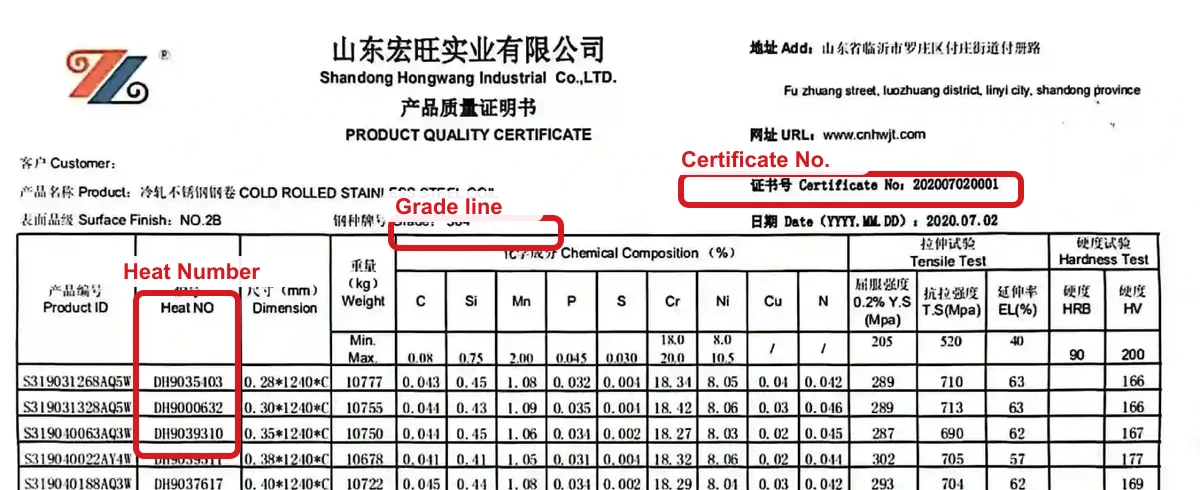
This guide uses a real 304 stainless steel quality certificate as the example. It is written for buyers in Vietnam, Indonesia, Thailand, Singapore and other Southeast Asia markets who need a fast way to check whether an MTC is useful before shipment.
Quick Answer
To read a stainless steel MTC, check these four items first.
- Heat Number: does it match the material or packing record?
- Grade and chemistry: does the table support 304, 316L or the quoted grade?
- Mechanical data: does the material meet the expected strength and elongation values?
- Stamp and standard: does the certificate show a traceable issuer, inspection basis and stamp?
If one of these points is missing or inconsistent, do not approve the shipment too quickly.
Beyond the Basics: 3 Hidden Details in an MTC That Protect Your Order
A normal-looking MTC can still hide risk. The useful question is not only "does the paper exist?" The useful question is "does this paper match the material and the order?"
1. Heat Number must connect paper to steel
The Heat Number is the traceability bridge. It should match the physical marking, label, packing record or batch photo. If the heat number only appears on the certificate and nowhere else, ask for proof before release.
2. Grade label is not enough
A certificate may say 304 or 316L in the heading. That is only the start. The chemistry table must support the grade claim.
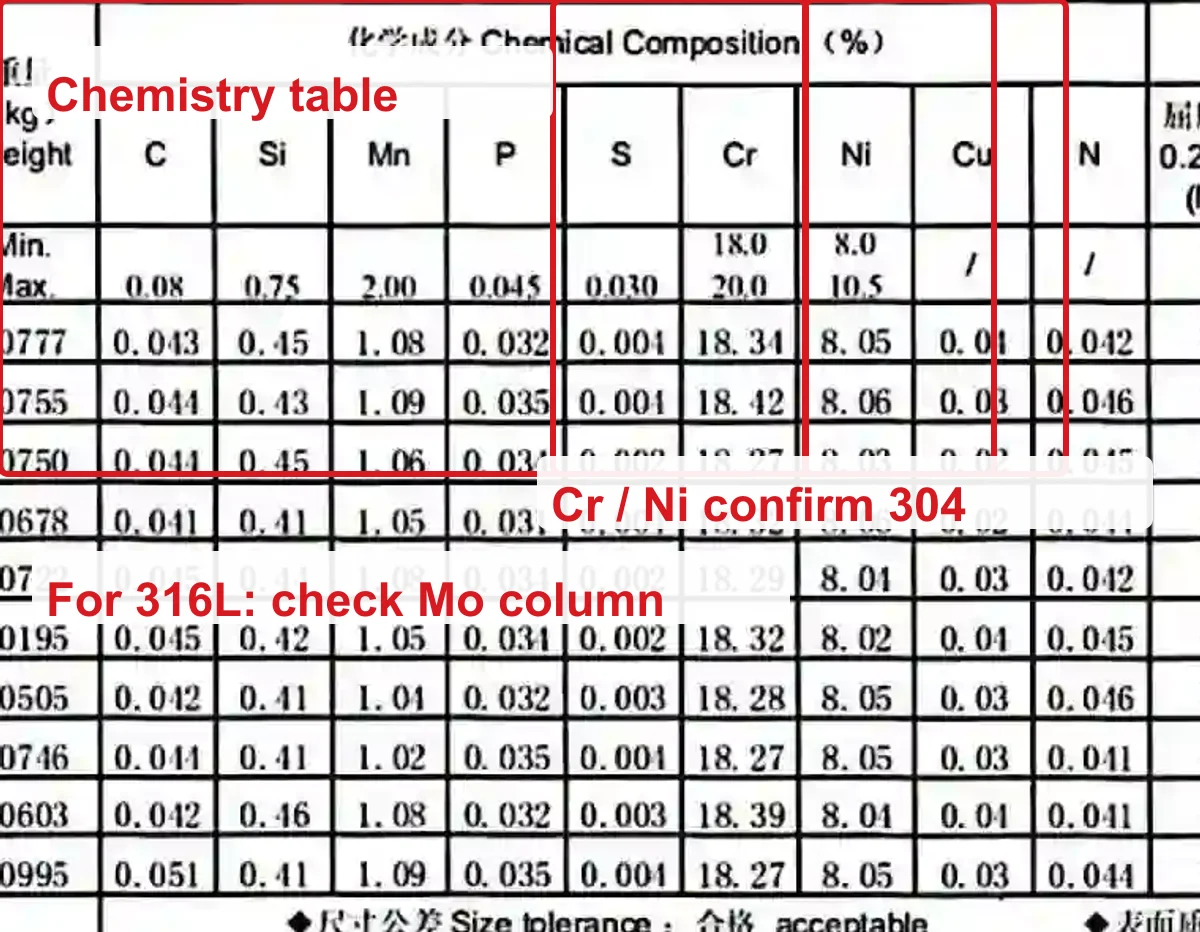
For example, 316L should show a meaningful Molybdenum (Mo) value. If a claimed 316L MTC has no Mo column or no useful Mo value, treat it as a red flag.
3. Stamp and standard should make sense
A real document should show a certificate number, issuer information, inspection basis and stamp or authorized inspection mark. The layout can differ by mill, but the traceability logic should still be clear.
Comparing 304 and 316L Chemical Composition on MTC
The chemistry table is the fastest way to check grade logic.
| Element | 304 Checkpoint | 316L Checkpoint | Why Buyers Care |
|---|---|---|---|
| Chromium (Cr) | Usually around 18% range | Usually around 16-18% range | Basic stainless corrosion resistance |
| Nickel (Ni) | Usually around 8% range | Usually higher than 304 | Supports corrosion resistance and ductility |
| Molybdenum (Mo) | Not required | Usually around 2-3% | Key for chloride and coastal resistance |
| Carbon (C) | Max value depends on standard | Lower carbon control expected | Helps reduce welding-related sensitization risk |
The real certificate used here is for 304 cold rolled stainless steel coil, not 316L bar. That is why the image is useful for reading structure, not for claiming it is a 316L example.
For a claimed 316L order, check the Mo value before you trust the label.
Common Red Flags: How to Spot a Fake Stainless Steel MTC
You cannot prove everything in three seconds. But you can catch obvious problems quickly.
Look for these warning signs:
| Fast Check | Warning Sign | What to Do Next |
|---|---|---|
| Heat Number | Different font, missing batch photo or no physical match | Ask for close-up marking photos |
| Grade vs chemistry | 316L label but no Mo value | Hold the review and request a clean MTC |
| Stamp area | Stamp looks pasted, cropped or unrelated to the document | Ask for original PDF or mill-side confirmation path |
| Certificate number | Missing or unclear number | Ask for a clearer copy before shipment |
| Tables | Numbers look misaligned or overwritten | Compare with purchase order and packing details |
A blurry scan is not always fake. Some real documents are scanned badly. But if the scan is blurry and the key data also looks inconsistent, slow down.
Mechanical Properties and QA Stamp: Do Not Skip the Right Side
Chemistry tells you what the steel is made of. Mechanical data tells you how it performs.
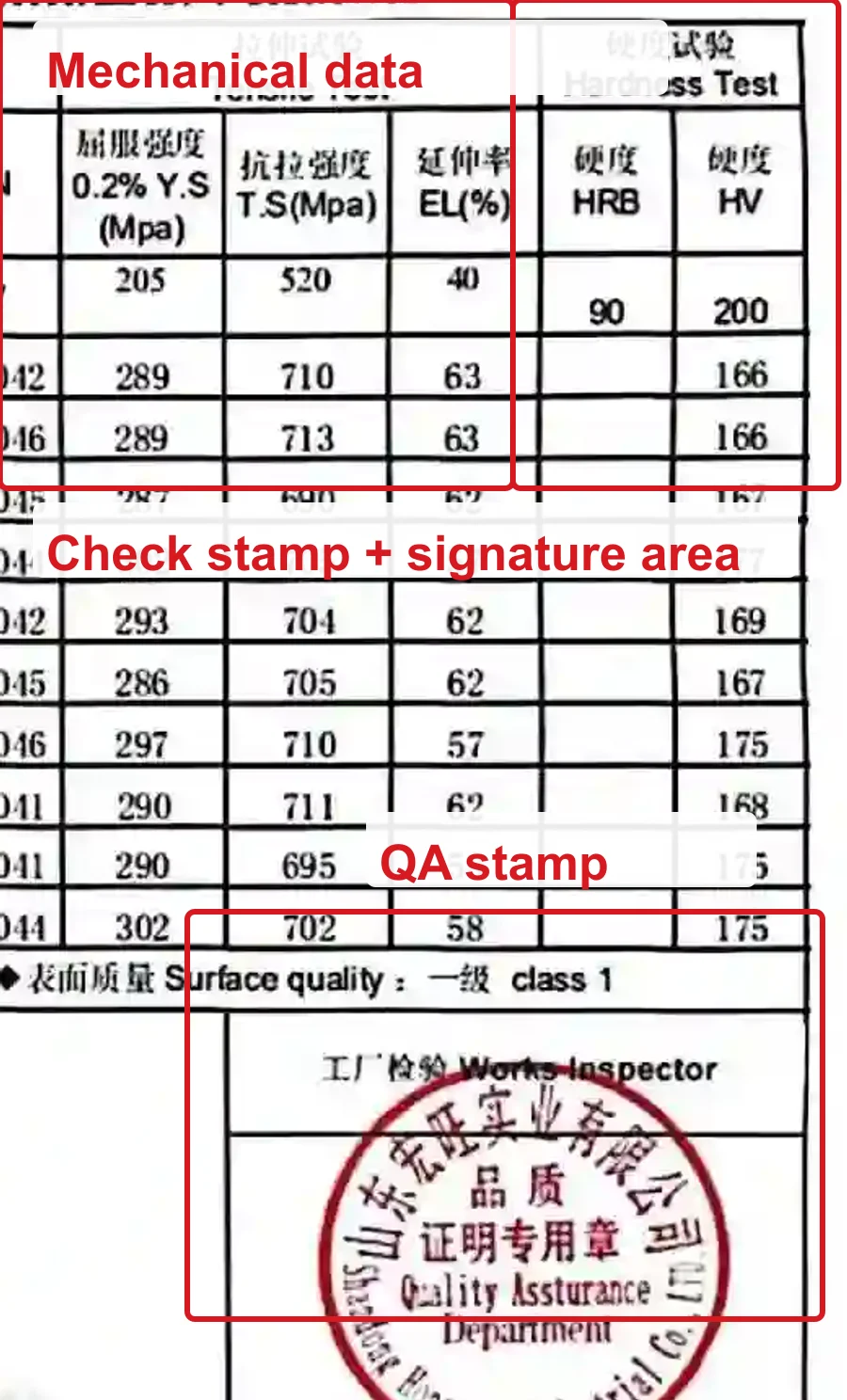
Look for yield strength, tensile strength, elongation and hardness where applicable. For flat products, pipes and bars, the exact test items may differ. What matters is that the data matches the product type and the project requirement.
If you are sourcing precision stainless steel bars, do not stop at chemistry. Tolerance and straightness also matter. You can compare that logic in our h9, h10 and h11 stainless steel bar tolerance guide.
Southeast Asia Import Check: Vietnam, Indonesia and Thailand
For Southeast Asia buyers, an MTC is not only a quality paper. It is also part of the import and project document set.
In Vietnam, buyers often need the MTC to match the commercial invoice, packing list and project material description. A small wording mismatch can slow internal review.
In Indonesia, import and project teams may pay close attention to origin, product description and certificate consistency. The MTC should not describe one material while the invoice describes another.
In Thailand, buyers working with industrial or Japanese-invested projects may need the MTC to align with the requested ASTM, JIS or EN reference. Confirm this before shipment, not after arrival.
FX Stainless Steel supports MTC consistency review for industrial projects in Vietnam, Indonesia and Thailand, helping buyers align certificates with packing lists, invoices and project document requirements.
MTC Review Checklist Before Shipment
Use this checklist before cargo release.
| Checkpoint | What to Confirm |
|---|---|
| Certificate number | Present and readable |
| Mill or issuer | Clear company name and document source |
| Heat Number | Matches marking, label or packing record |
| Grade | Matches purchase order and quotation |
| Chemistry | Supports 304, 316L or the quoted grade |
| Mechanical data | Fits product type and project requirement |
| Standard | ASTM, JIS, EN or agreed inspection basis is clear |
| Stamp / signature | Present and not obviously pasted or cropped |
| Document set | MTC, invoice, packing list and labels are consistent |
If the order involves bars for machining, also check finish, tolerance and heat traceability before shipment. For bar options, start from our stainless steel bar supply hub. If the supplier has already sent the certificate and is asking for payment or loading release, use the follow-up MTC shipment release checklist.
Conclusion
A stainless steel MTC is useful only when it connects the document, the material and the order. Do not trust the grade label alone. Check the Heat Number, chemistry table, mechanical data and stamp area together.
For Southeast Asia buyers, this review can prevent wrong-grade disputes, document delays and unnecessary shipment risk.
Frequently Asked Questions (FAQ)
Q. How can I tell if a stainless steel MTC is fake or edited?
A. Check whether the Heat Number, certificate number, grade line, chemistry table and inspection stamp look consistent. Different fonts, blurry edits, missing mill details or a claimed 316L certificate without a clear Molybdenum (Mo) value are warning signs.
Q. Why does the Heat Number matter on a stainless steel MTC?
A. The Heat Number links the certificate to the actual steel batch. If the heat number on the MTC does not match the physical marking or packing record, the document cannot prove that the tested material is the same material being shipped.
Q. How do I verify 304 vs 316L on a Mill Test Certificate?
A. Do not rely only on the grade label. For 304, check that chromium and nickel match the expected range. For 316L, also check that the chemistry table shows a meaningful Molybdenum (Mo) value and low carbon control.
Q. What should Vietnam and Indonesia buyers check before customs clearance?
A. Buyers should check that the MTC, invoice, packing list, product labels and shipment documents use consistent material descriptions, heat numbers and standards. This helps reduce document questions during import or project review.
Q. Can FX Stainless Steel review my MTC before shipment?
A. FX Stainless Steel can help review whether the MTC, order specification and physical material information are consistent before shipment. This is a practical document review, not an official legal authentication service.
CTA
If you want help reviewing an MTC before shipment, send the certificate, grade, dimensions, quantity and destination market to FX Stainless Steel on WhatsApp or through our inquiry page. For bar orders, you can also review our stainless steel bar supply hub before confirming grade, finish and traceability requirements.