
Singapore & Vietnam: 304 vs 316 Stainless Steel for Coastal Projects
Compare 304 vs 316 stainless steel for coastal projects in Singapore, Vietnam and Thailand, including corrosion risk, cost trade-offs and grade verification before shipment.
In This Guide
Introduction
In humid and salt-rich project environments across Singapore, Ho Chi Minh City and other coastal areas of Vietnam, the wrong grade choice can create staining, premature maintenance and avoidable replacement cost. For many buyers, the real question is not whether 304 Stainless Steel or 316 Stainless Steel is the more famous grade, but which one fits the actual chloride exposure, fabrication method and service life target of the project.
This guide is mainly about the 304 vs 316 stainless steel decision for Southeast Asia coastal projects. If you prefer the Chinese version written for local sourcing teams, read the Chinese guide for Singapore, Vietnam and Thailand coastal projects. If you already know the project faces heavy salt spray, chloride-rich water or difficult long-term maintenance, our separate guide on when 304 is not enough for marine service goes deeper into the 316L upgrade path.
Quick Answer
Choose 304 Stainless Steel for general indoor or light industrial use when daily corrosion resistance is enough. Choose 316 Stainless Steel when the project faces chloride, coastal air, marine exposure or chemical conditions where stronger pitting resistance matters more.
For Singapore, Vietnam and Thailand coastal projects, the decision should start with exposure: indoor and protected use may still fit 304, while outdoor, salt-laden, marine or chloride-rich service usually deserves a serious 316 or 316L review before the buyer locks the purchase order.
Why Chemical Composition Matters
The most important technical difference is Molybdenum (Mo). 316 Stainless Steel typically contains around 2-3% Mo in addition to chromium and nickel, while 304 Stainless Steel does not. That added Molybdenum (Mo) improves resistance to chloride pitting, one of the main corrosion risks in marine and coastal environments.
In indoor or lower-risk conditions, 304 often gives buyers a strong balance of cost and performance. Once exposure becomes more aggressive, 316 usually gives the project a safer corrosion margin. The final grade wording should still follow the drawing, purchase order and accepted standard, such as ASTM A240 for plate and sheet orders, ASTM A276 for bar orders, or the EN 10088 series where European wording is required.
304 vs 316 Quick Comparison
| Feature | 304 Stainless Steel | 316 Stainless Steel |
|---|---|---|
| Typical composition | 18% Cr, 8% Ni | 16% Cr, 10% Ni, 2% Mo |
| Corrosion resistance | High for general use | Stronger for marine and chloride exposure |
| Pitting resistance | Moderate | Better in salt-rich environments |
| Common applications | Kitchen equipment, indoor panels, trim, tanks | Coastal facades, marine parts, chemical processing lines |
| Cost level | More economical upfront | Higher upfront, stronger lifecycle value |
Application Scenarios for Singapore, Vietnam and Thailand
Inland & General Use
For inland or lower-exposure use, 304 Stainless Steel is often the right commercial decision. This includes indoor decorative panels, kitchen equipment, architectural trim and general fabrication in places such as inland Thailand or lower-chloride project conditions away from the shoreline.
Buyers should still confirm whether the part will be cleaned regularly, whether it will touch process water, and whether the final customer requires a specific standard or MTC wording. A protected indoor part in Vietnam is not the same buying decision as an exposed coastal handrail near Da Nang.
Coastal & Marine Projects
For coastal and marine-related projects, the balance changes. Around Singapore, Da Nang, Ho Chi Minh City and coastal Thailand, moisture and airborne salt can accelerate tea staining and chloride pitting on 304 over time. For outdoor architectural cladding, marine hardware, process piping and chemical-related installations, 316 Stainless Steel is usually the stronger comparison choice.
The important point is not to upgrade blindly. Ask where the part sits, how often it is exposed to salt spray, whether welding is involved, and how hard maintenance will be after installation. Those answers decide whether 316 is enough, whether 316L should be reviewed, or whether a more corrosion-resistant route is needed.
2026 Sourcing Tips: How to Verify Your Grade
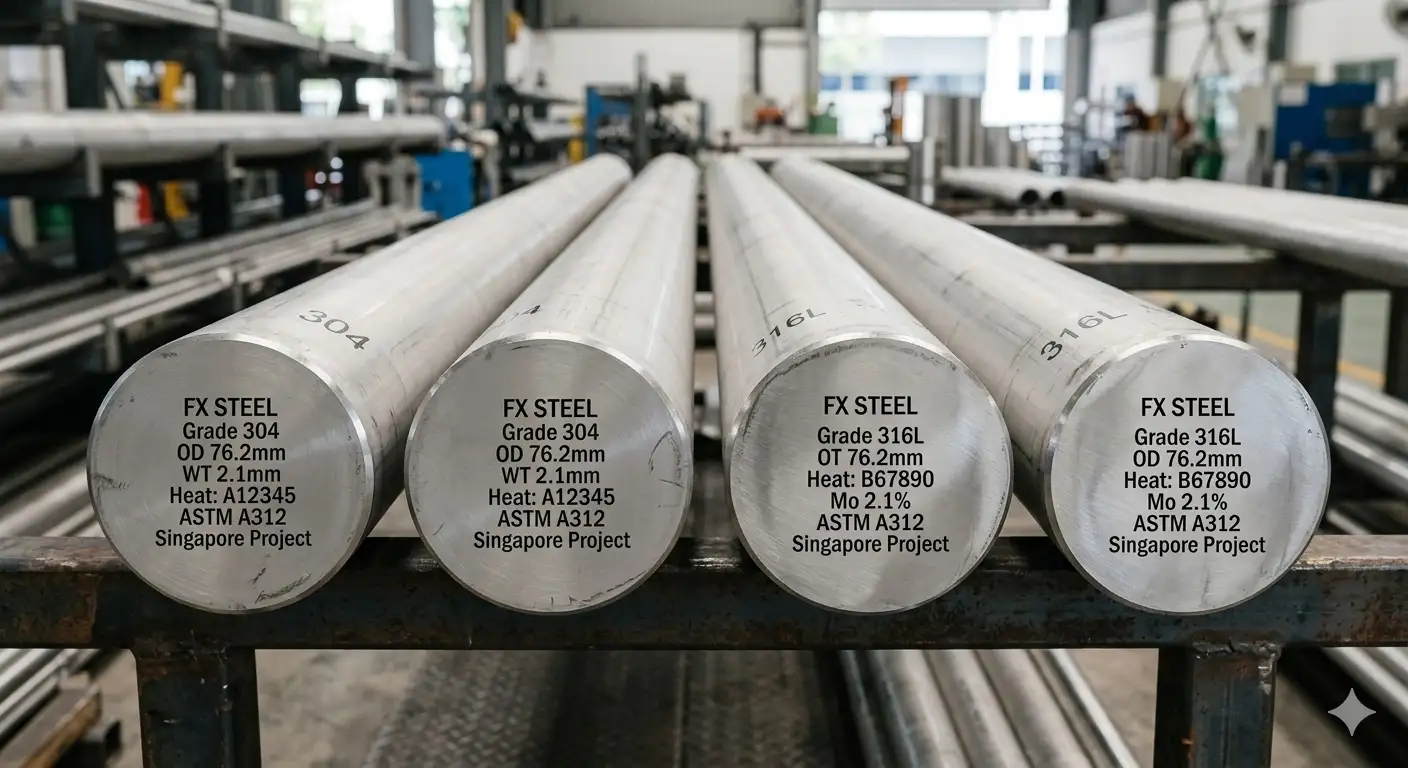
In a tighter export environment, buyers should verify the actual grade instead of relying only on quotation wording. A professional China Steel Supplier should be able to support spectrometer testing to confirm nickel and Molybdenum (Mo) content, provide mill test certificates that match the heat numbers on the coils, plates or bars, and explain when an L-grade is preferable for welding-related applications.
At FX Stainless Steel, we treat grade verification as part of project risk control, not as an optional extra. If you want to understand how our broader export coordination works, you can also read Why FX Stainless Steel Is a Reliable 2026 Stainless Steel Partner for Southeast Asia.
Sources
Useful public references for this guide include ASTM A240/A240M stainless steel plate, sheet and strip, ASTM A276/A276M stainless steel bars and shapes, EN 10088-2 stainless steel flat products, EN 10088-3 stainless steel bars, rods, wire and sections, and EN 10204 metallic products inspection documents.
Conclusion
The cheapest grade is not the one with the lowest invoice number. It is the one that remains suitable for the environment, fabrication method and expected service life of the project. If your application is inland and relatively low risk, 304 Stainless Steel may be enough. If your project faces humid coastal air, chloride exposure or marine conditions in Singapore, Vietnam or Thailand, 316 Stainless Steel is often the safer engineering choice.
If the comparison has already moved beyond "304 or 316" and the real question is whether 304 has become too risky for marine service, continue with our guide on when 304 is not enough for marine service.
Frequently Asked Questions (FAQ)
Q. When is 316 stainless steel usually preferred over 304 for coastal projects?
A. 316 stainless steel is usually preferred when the part faces salt-laden air, chloride exposure or outdoor service where pitting resistance matters more than lowest upfront cost.
Q. Is the price difference between 304 and 316 worth it for Vietnam industrial use?
A. It depends on the environment. For inland or low-risk use, 304 may still be enough. For coastal, marine or chloride-rich service, the higher cost of 316 can be easier to justify because it helps reduce corrosion-related maintenance risk.
Q. How can I verify whether the material is really 316 instead of 304?
A. Request the Mill Test Certificate (MTC), check the chemistry table for Molybdenum (Mo), and match the heat number with the actual material or packing record before release.
CTA
If you are comparing grades for a coastal or industrial project, send your environment, dimensions, quantity and destination to FX Stainless Steel on WhatsApp or request a professional quote. You can also review 304/304L stainless steel bar and 316/316L stainless steel bar before confirming the grade path.