What Buyers Should Check on a Stainless Steel MTC Before Shipment Release
A shipment release checklist for stainless steel buyers: check grade wording, chemistry, heat number, labels, packing list, EN 10204 certificates and PMI before payment or loading release.
In This Guide
- Why the MTC Matters Before Payment
- Quick Answer: Six Checks Before Shipment Release
- Grade Wording: Do not accept vague equivalent language
- Chemical Composition: Read the grade logic, not only the grade name
- Heat Number Traceability: MTC, labels and packing list must connect
- Mechanical Properties: When Buyers Must Look Beyond Chemistry
- MTC vs Certificate Types: EN 10204 3.1, 3.2 and Mill Certificate
- PMI and Third-Party Inspection: When to Add Another Check
- Common Mistakes Before Shipment Release
- RFQ Wording Example for MTC Requirements
Why the MTC Matters Before Payment
A stainless steel MTC is most useful before payment balance, container loading or shipment release. If the buyer waits until the cargo arrives, the material may already be in the warehouse, customs documents may already be filed, and both sides may start arguing from a weaker position.
This article is not a basic explanation of what an MTC is. If you need that foundation first, read our how to read a stainless steel MTC guide. This page is for the later moment: the supplier says the goods are ready, sends the MTC, and asks for release.
On one project shipment, the MTC showed 304 chemistry but the bundle labels said 316L. The buyer did not catch the mismatch until the container arrived. Both sides blamed the mill, but the real control point was missed before shipment. A pre-release MTC check is not paperwork. It is a buying control.
Quick Answer: Six Checks Before Shipment Release
Before you approve payment or loading, check these six points:
- Grade wording: does the MTC match the PO, drawing and quotation wording?
- Chemical composition: do Cr, Ni, Mo and C support the claimed grade?
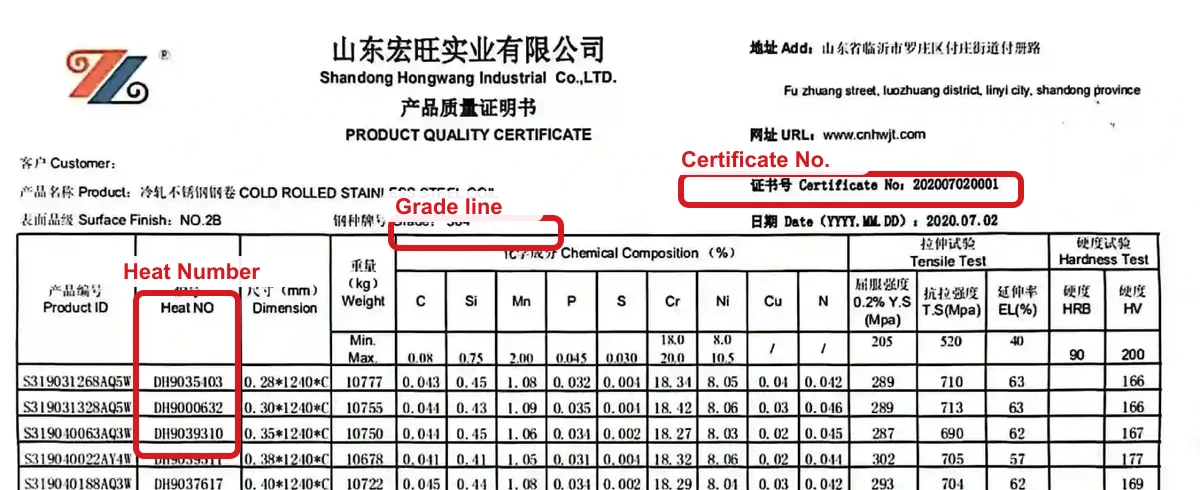
- Heat number: does the MTC heat number match labels and packing list?
- Mechanical properties: are tensile, yield and elongation present when the project requires them?
- Certificate type: is EN 10204 3.1 enough, or does the order require 3.2?
- Inspection support: do you need PMI, XRF, label photos or third-party inspection before release?
If one point does not match, hold release and ask for a corrected document set or supporting photos before the cargo leaves.
Grade Wording: Do not accept vague equivalent language
Grade wording should match the buying document. A quotation may say 304, but the drawing may require ASTM A240 304, TP304, SUS304, EN 1.4301, UNS S30400 or GB/T wording. These names may point to related stainless steel grades, but they are not interchangeable in every project document.
The safest pre-shipment habit is simple: compare the MTC grade line with the PO, drawing, label and packing list. If the MTC says only "304 equivalent", ask for exact standard wording. Do not approve shipment based on a loose phrase when the end user or customs team expects ASTM, JIS, EN, UNS or GB/T wording.
This matters across product forms. A buyer checking 304 stainless steel plate, 304 stainless steel pipe or 304/304L stainless steel bar should not only ask whether the material is "304". The document language should be close enough for the real receiving process.
For cross-standard naming, use the stainless steel grade equivalent lookup, but keep the final MTC wording aligned with the purchase order.
Chemical Composition: Read the grade logic, not only the grade name
The chemistry table is where a lot of wrong-grade problems show themselves. For 304, buyers usually check chromium and nickel first. 304 does not require molybdenum as a grade feature. If a supplier presents a document in a way that tries to make 304 look like 316L, slow down and compare the actual values.
For 316L, molybdenum is one of the key checks. A claimed 316L MTC with no meaningful Mo value should not pass a serious review. In many standard systems, 316L Mo is commonly around the 2.0 to 3.0 percent range. If the value is below 1.8 percent or the Mo column is missing, hold release and ask for clarification before shipment.
Carbon also matters. The L in 316L or 304L points to low carbon control. If the buyer ordered low-carbon material for welding or project documentation, do not approve only by the title line. Check the C value in the table.
For 316L products, this same logic applies to 316 stainless steel plate, 316L stainless steel pipe and 316/316L stainless steel bar. Chemistry is not the whole inspection, but it is the fastest way to catch a grade story that does not make sense.
Heat Number Traceability: MTC, labels and packing list must connect
A heat number is useful only when it connects the paper to the physical material. The MTC should show the heat number. The bundle label, coil label, pipe tag or bar label should show the same heat number or a traceable batch reference. The packing list should not describe a different lot.
A batch can be traced back to a specific heat only if the heat number on the MTC matches the label on the bundle and the packing list. If any one does not match, traceability is broken. It may still be fixable, but it is not ready for blind release.
Before payment, ask for clear photos of labels on the actual bundles or pallets. For mixed shipments, ask the supplier to mark which heat number belongs to which size and product form. This is especially important when one container includes plate, pipe, bar and coil together.
Mechanical Properties: When Buyers Must Look Beyond Chemistry
Not every routine stainless steel order needs a deep mechanical review, but some orders do. If the material will be used for pressure-related parts, valve bodies, pipe systems, shafts, project-controlled fabrication or structural supports, mechanical values should not be ignored.
Look for tensile strength, yield strength and elongation where the relevant standard or project document requires them. The values should fit the product form and grade. A plate MTC, pipe MTC and bar MTC may not present the same table, so the buyer should compare against the correct order requirement.
For pressure-related pipe or higher-risk service, review 316L stainless steel pipe and confirm whether the project needs additional inspection. For higher-strength or corrosion-sensitive bar applications, duplex stainless steel bar may require tighter document and test review.
MTC vs Certificate Types: EN 10204 3.1, 3.2 and Mill Certificate
A normal mill certificate and an EN 10204 certificate are not always treated the same by project buyers. EN 10204 3.1 is commonly requested for stainless steel supply because it is issued by the manufacturer with test results for the supplied material. For many routine plate, pipe, bar and coil orders, 3.1 may be enough.
EN 10204 3.2 goes further. It involves inspection validated by the manufacturer's authorized inspection representative and either the buyer's representative or an independent inspection body, depending on the agreed arrangement. Buyers usually consider 3.2 for pressure equipment, oil and gas, chemical projects, government-controlled projects or orders where the end user requires independent verification.
The key is to agree this before production or shipment. Asking for 3.2 after the goods are ready can delay release and add cost. If the project requires 3.2, write it clearly in the RFQ and PO.
PMI and Third-Party Inspection: When to Add Another Check
PMI, XRF or third-party inspection is not necessary for every small stainless steel order. It adds cost and time. But it can be a sensible control when the cost of wrong material is high.
Consider PMI before shipment when the order involves 316L, duplex, mixed grades in one shipment, chemical service, oil and gas, pressure components, critical spares or a supplier you have not worked with before. PMI does not replace the MTC, but it can confirm whether the actual material surface roughly matches the claimed alloy family.
For 316/316L stainless steel bar and duplex stainless steel bar, PMI can be useful when several heats, sizes or grades are packed together. Ask for the test scope, number of pieces checked, photo evidence and report format before release.
Common Mistakes Before Shipment Release
The mistakes are usually simple, which is why they are easy to miss when everyone is rushing to load.
- Only reading the grade name and not the chemistry range.
- Not checking the heat number against bundle labels.
- Accepting "304 equivalent" when the PO requires exact standard wording.
- Forgetting to ask whether labels and packing list match the MTC.
- Finding out after arrival that the MTC is a poor scan, not a clear original PDF.
- Approving a mixed container without checking which heat belongs to which product.
A practical rule: if the document would not help your receiving team identify the material after arrival, it is not good enough for shipment release.
RFQ Wording Example for MTC Requirements
Use wording like this before placing the order, not after the goods are ready:
Please provide MTC before shipment release. The MTC must show exact grade and standard wording, heat number, chemical composition, mechanical properties where required, product description and certificate type. Heat number on MTC, physical labels and packing list must match. Please send label photos and packing list for review before balance payment. PMI or third-party inspection to be confirmed before production if required.
For document review before shipment, send the MTC, PO, label photos, packing list and product specification through our contact page.
FAQ
Q. Should I approve shipment if the MTC grade and bundle label do not match?
A. No. Hold the release and ask the supplier to explain and correct the document set. The MTC, physical label and packing list should use consistent grade wording and heat number logic before payment or loading release.
Q. Is an EN 10204 3.1 certificate enough for every stainless steel order?
A. Not always. EN 10204 3.1 is common for many stainless steel orders, but critical pressure, oil and gas, chemical or project-controlled orders may require EN 10204 3.2, PMI, third-party inspection or additional test records.
Q. When should buyers request PMI before shipment?
A. PMI is worth reviewing when the order involves 316L, duplex, chemical service, oil and gas, pressure-related parts, mixed heats or any situation where wrong grade substitution would be expensive after arrival.
CTA
Preparing to release a stainless steel shipment? Send the MTC, purchase order wording, label photos, packing list, product form, size and destination to FX Stainless Steel. We can help review whether the document set is consistent before shipment release.