304 vs 316L Stainless Steel Coil: What Buyers Should Confirm Before Ordering
A practical comparison of 304 and 316L stainless steel coil, covering chloride exposure, welding, surface finish, slitting, edge condition, MTC checks and RFQ wording.
In This Guide
- Introduction
- Quick Answer: 304 or 316L Stainless Steel Coil?
- 304 vs 316L Coil: What Changes in the Material?
- When 304 Stainless Steel Coil Is Usually Enough
- When Buyers Should Consider 316L Coil
- Surface Finish: 2B, BA, No.4 or HL?
- Slitting and Edge Condition: What Can Stop a Production Line
- MTC and Traceability Checks Before Shipment
- Copy-Paste RFQ for 304 or 316L Stainless Steel Coil
- How FX Stainless Steel Handles a Coil Inquiry
Introduction
Choosing between 304 and 316L stainless steel coil is not simply a choice between a lower-cost grade and a more corrosion-resistant one. The answer depends on what the coil will become, what it will contact, how it will be formed or welded, and what the purchase order requires.
A buyer can select the correct grade and still receive the wrong material for production. A coil with the wrong width tolerance, edge condition, inner diameter or protective film can stop a stamping or roll-forming line. A correct MTC is also not enough if its heat number cannot be connected to the slit coils delivered to the factory.
This guide compares 304 vs 316L stainless steel coil from the ordering side: grade selection, surface finish, slitting quality, MTC checks and the details that belong in the RFQ.
Quick Answer: 304 or 316L Stainless Steel Coil?
304 stainless steel coil is usually the first grade to consider for indoor equipment, appliance parts, kitchen equipment, general enclosures, stamped components and fabrication that does not face meaningful chloride or aggressive chemical exposure. 316L stainless steel coil deserves attention when the finished part will face salt spray, chloride-bearing water, coastal air, chemical cleaning, corrosive process media or weld-sensitive service.
Neither grade should be approved from the application name alone. Ask where the part will be installed, what it will contact, whether liquid can remain in crevices, how often it will be cleaned, and whether the drawing or end user names an exact grade. If those details are unknown, quote 304 and 316L as separate options rather than presenting one as a guaranteed answer.
| Buyer question | 304 coil is often considered when | 316L coil deserves attention when |
|---|---|---|
| Exposure | Indoor or controlled conditions | Persistent chloride, salt spray or chemical exposure |
| Fabrication | General forming, stamping or light fabrication | Welding is significant and low-carbon wording is required |
| Appearance risk | Cleaning and maintenance are accessible | Surface staining or pitting would be difficult to correct |
| Specification | Drawing accepts 304 / SUS304 | PO requires 316L / SUS316L / S31603 |
| Budget decision | Extra corrosion margin is not justified by service | Replacement or downtime would cost more than the grade difference |
304 vs 316L Coil: What Changes in the Material?
The useful difference for buyers is not that one grade is universally good and the other is universally better. Under ASTM A240/A240M chemistry limits, 316L includes molybdenum and has a lower maximum carbon content than 304. Molybdenum improves resistance to chloride pitting. The lower carbon limit helps reduce sensitization risk during welding, although fabrication procedure and service conditions still matter.
| ASTM A240 chemistry item | 304 | 316L | What the buyer should take from it |
|---|---|---|---|
| Carbon (C), max. | 0.08% | 0.030% | Low-carbon 316L is commonly specified for welded fabrication |
| Chromium (Cr) | 18.0-20.0% | 16.0-18.0% | Confirm the heat falls within the ordered grade range |
| Nickel (Ni) | 8.0-10.5% | 10.0-14.0% | Check actual heat chemistry on the MTC |
| Molybdenum (Mo) | No required addition | 2.00-3.00% | Provides 316L with more chloride-pitting resistance than 304 |
These ranges follow ASTM A240/A240M. The PO should name the required standard and grade, and the certificate should be checked against the current standard edition and any project-specific limits. Do not accept a sales description such as "marine grade" in place of exact material wording.
When 304 Stainless Steel Coil Is Usually Enough
304 coil often makes sense for appliance panels, indoor equipment covers, kitchen components, general stamped parts, cabinets and fabricated products used in controlled environments. It balances corrosion resistance, fabrication performance, availability and cost for many ordinary manufacturing jobs. See the 304 stainless steel coil specification and processing details.
The decision still needs context. Food equipment that sees routine cleaning is not the same as a tank holding hot brine. An enclosure installed indoors is not exposed like an outdoor cabinet near salt spray. Even within one factory, a dry equipment cover and a wet processing area may require different material choices.
Do not use a fixed distance from the coast as a grade rule. Wind, shielding, rainfall, cleaning, crevice design and maintenance can change exposure sharply within the same city. For projects in Singapore, Vietnam, Thailand, Malaysia, Indonesia or the Middle East, send the supplier the installation environment instead of relying only on the destination country.
When Buyers Should Consider 316L Coil
316L becomes a stronger candidate when chloride exposure, chemical contact, cleaning media or welding raises the consequence of selecting 304. Typical discussions include coastal equipment, chemical and pharmaceutical fabrication, food-processing areas with salt-bearing media, water-treatment components, marine-adjacent enclosures and welded vessels where the project specifies a low-carbon grade. See the 316L stainless steel coil page for finish, edge and processing routes.
There are also conditions where 316L may not be enough. Warm seawater, stagnant chloride solution, tight crevices, high temperature, reducing acids or an aggressive cleaning process can exceed what a generic 316L label can promise. In those cases, the material choice may need duplex, super duplex, a nickel alloy, a coating system or a design change. The process engineer or end user should approve that route.
The practical question is not "Is 316L corrosion-proof?" It is "Does 316L provide enough margin for the stated medium, concentration, temperature, cleaning method and component design?" A supplier needs those facts before making a meaningful recommendation.
Surface Finish: 2B, BA, No.4 or HL?
Surface finish affects appearance, cleaning, fabrication and inspection, so it should be written into the RFQ and PO rather than agreed from a reference photo. 2B is a common cold-rolled mill finish for industrial fabrication. BA provides a brighter surface. No.4 and HL are directional polished finishes often chosen for visible panels, kitchens, lifts and architectural work.
| Finish | Common purchasing use | Confirm before ordering |
|---|---|---|
| 2B | General fabrication, equipment parts, formed components | Surface standard, scratch acceptance and whether film is needed |
| BA | Bright panels, cleanable parts and decorative fabrication | Gloss expectation, handling marks and protective film |
| No.4 | Brushed panels and visible equipment surfaces | Grit reference, grain direction, sample and film |
| HL | Long directional decorative finish | Grain continuity, processing direction and acceptable joint appearance |
A finish name does not define every visual detail. No.4 and HL can vary by abrasive route, line, base material and sample. If finished panels will sit next to each other, approve a physical sample or agreed photo standard, keep grain direction consistent, and avoid mixing production batches without checking appearance. Our stainless steel surface finish guide covers these acceptance points in more detail.
Slitting and Edge Condition: What Can Stop a Production Line
For slit coil, grade is only one part of production fit. Burr, camber, edge wave, coil shape and surface damage can affect stamping, roll forming, tube making and automated feeding. The limits should come from the buyer's equipment or drawing. A universal percentage copied into every PO may be too loose for one line and unnecessarily expensive for another.
Confirm these points with the processor:
- Final slit width and tolerance: state the measured width and accepted variation.
- Edge condition: choose mill edge, slit edge, deburred or rounded edge according to handling and forming needs.
- Burr direction and maximum height: give a numeric limit when the production line requires one.
- Camber or side bow: align the tolerance with feed length and tracking sensitivity.
- Edge wave and coil shape: define what the uncoiler and forming line can accept.
- Coil ID: 508 mm and 610 mm are common options, but the ID must match the uncoiler or available adapter.
- Maximum coil weight and OD: check crane, forklift, rack and uncoiler capacity.
- Paper interleave or protective film: confirm side, film type, adhesion and temperature requirements.
- Labels after slitting: each daughter coil should remain traceable to the original heat and mother coil.
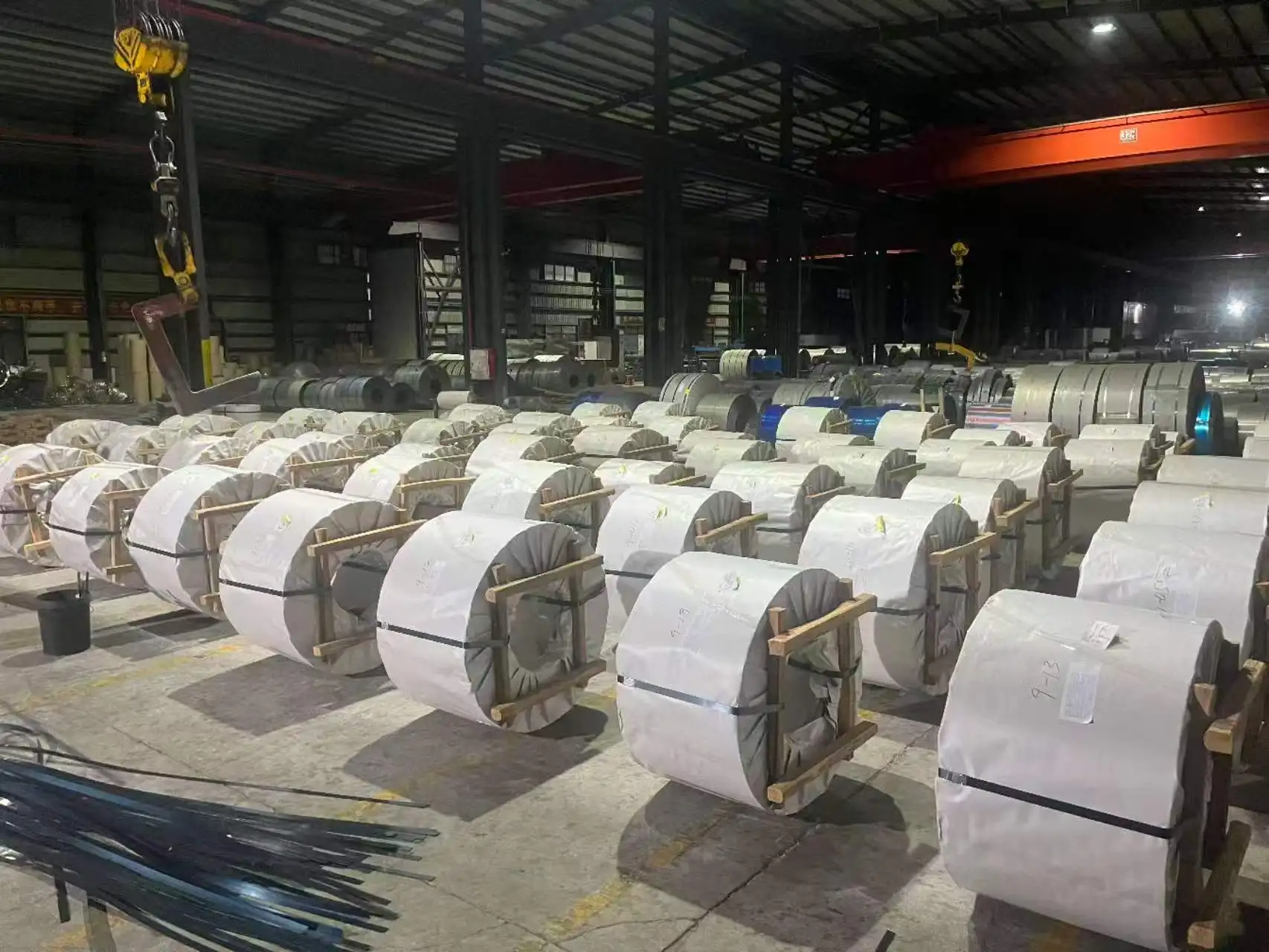
Photos of the edge, coil eye, labels and packed coil are useful before loading. For a trial order, it is also sensible to confirm how the first slit coil runs before turning a new tolerance into a larger repeat program.
MTC and Traceability Checks Before Shipment
Before shipment release, match the MTC to the purchase order and physical coils. For 304, check the required standard, grade wording, Cr and Ni values, mechanical properties and heat number. For 316L, also check that carbon and molybdenum fall within the required specification. Do not approve 316L only because the file name or sales invoice says 316L.
The traceability chain should connect the heat number and material description on the MTC, the mother-coil and slit-coil labels, and the packing list and shipment marks. If the coil was slit into several widths, ask for label photos from the finished daughter coils. When grade substitution would create serious cost after arrival, PMI or third-party inspection can be added to the agreed inspection scope. Our MTC checklist before shipment release explains when to hold cargo and ask for corrected documents.
Copy-Paste RFQ for 304 or 316L Stainless Steel Coil
A useful coil RFQ tells the supplier what must fit the production line, not only the grade and tonnage. Replace the bracketed items below with your order details.
Subject: RFQ - 304 / 316L Stainless Steel Coil
- Application: [equipment panel / stamping / tube forming / other]
- Grade: [ASTM A240 304 / 316L / SUS304 / SUS316L]
- Thickness and tolerance: [ ]
- Final width and tolerance: [ ]
- Surface finish: [2B / BA / No.4 / HL]
- Edge condition and burr limit: [ ]
- Processing: [mill coil / slitting / cut-to-length]
- Coil ID: [508 mm / 610 mm]
- Maximum coil weight and OD: [ ]
- Protective film or paper interleave: [ ]
- Quantity: [ ]
- Documents: MTC with heat number [and PMI / inspection if required]
- Packing and label requirements: [ ]
- Trade term and destination: [FOB / CIF, port]
Please confirm the offered standard, processing route, packing method and delivery schedule with the quotation.
If you are comparing both grades, ask for separate 304 and 316L offers against the same size, finish, processing and packing scope. A lower quote is not comparable if it assumes mill edge while the other includes precision slitting, film and stricter tolerances.
How FX Stainless Steel Handles a Coil Inquiry
When we receive a 304 or 316L coil inquiry, we first check the intended use and the details that affect processing: thickness, width, surface, edge, coil ID, maximum coil weight and destination. If the grade is still open, we need the exposure and fabrication conditions before comparing options.
For slit or visible-surface orders, we also confirm burr requirements, grain direction, film, coil labels and packing. Before shipment, the MTC and heat number should remain connected to the finished coils and packing list. Stock availability, processing route and delivery timing depend on the final specification and current material position.
Conclusion
304 stainless steel coil is often the sensible choice for general indoor manufacturing and controlled environments. 316L adds molybdenum for better chloride-pitting resistance and uses a lower carbon limit that is useful in many welded applications. That does not make 316L a universal corrosion guarantee.
A sound order connects grade selection with the actual environment, then locks down finish, thickness, width, edge, coil ID, weight, labels, MTC and packing. Those details usually decide whether the coil runs smoothly when it reaches the buyer's factory.
Frequently Asked Questions (FAQ)
Q. Is 316L stainless steel coil always better than 304 coil?
A. No. 316L offers more resistance to chloride pitting and has lower carbon for weld-sensitive fabrication, but 304 is often suitable for indoor, general fabrication and controlled environments. The application, cleaning chemicals, exposure, project specification and lifecycle risk should decide the grade.
Q. Can 304 stainless steel coil be used in a coastal project?
A. Sometimes, but the word coastal is not enough to approve it. Buyers should check salt exposure, shielding, cleaning frequency, surface design, crevices, expected appearance and maintenance access. For persistent chloride or sea-spray exposure, 316L or another project-approved material may provide more margin.
Q. What should I check on an MTC for 316L stainless steel coil?
A. Check the exact grade and standard, carbon, chromium, nickel and molybdenum values, heat number, mechanical properties and product description. The heat or coil number should also match the physical coil labels and packing list, including labels applied after slitting.
Q. What coil details should be included in an RFQ besides grade?
A. Include thickness and tolerance, width, surface finish, edge condition, coil ID, maximum coil weight, slitting or cut-to-length requirements, protective film, MTC, labeling, packing, quantity and destination. State the application when grade selection is still open.
CTA
Preparing a 304 or 316L stainless steel coil order? Send the application, grade, thickness, width, surface finish, edge condition, coil ID, maximum coil weight, quantity, MTC requirement and destination through our contact page. FX Stainless Steel will check the available coil and processing route before preparing the quotation.