RoHS Test Report for 303, 304F and 316F Stainless Steel Bars: A Germany Export Case
A real RoHS document-support case for 303, 304F and 316F stainless steel bar samples tested by CTI before Germany / EU EEE-related export review.
In This Guide
- Introduction
- Quick Answer
- Why the Buyer Asked for RoHS Documents
- What RoHS Means for Stainless Steel Bar Buyers
- Case Process: From Sample Submission to Report Review
- What Was Tested in 303, 304F and 316F
- Why 303, 304F and 316F May Appear in the Same Document Request
- How Buyers Should Request RoHS / MTC / Export Documents
- Practical Lessons from This Case
- Important Compliance Note
- Request RoHS and MTC Document Support
Introduction
A recent buyer asked us a practical document question before shipment:
The stainless steel bar material would be used in downstream parts related to export to Germany and the EU market. The buyer needed more than a normal quotation. They also wanted RoHS testing support for the bar samples before moving forward.
This is a common situation in industrial sourcing. The material itself may be a stainless steel bar, but the final product may enter an electrical or electronic equipment supply chain. When that happens, buyers often need extra documents to satisfy their customer, quality team or compliance checklist.
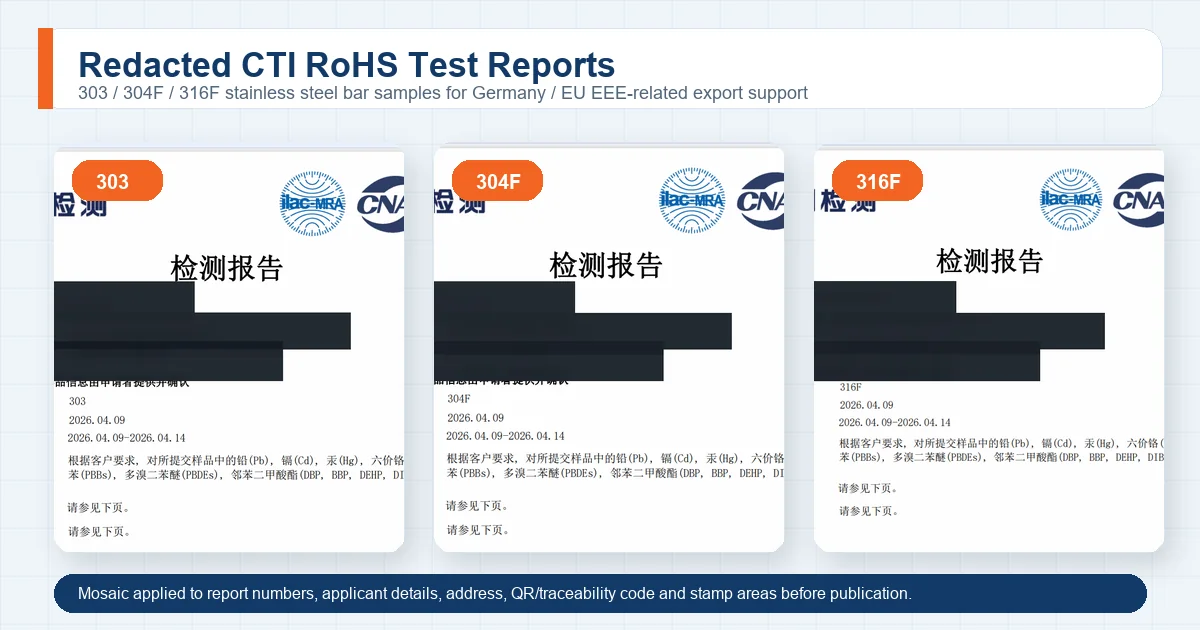
For this case, 303, 304F and 316F stainless steel bar samples were submitted to CTI / 华测检测 for RoHS-related testing.
The important point is simple: we are not saying every raw stainless steel bar exported to Germany automatically requires a RoHS test report. The need depends on the final product, buyer requirement and compliance context.
Quick Answer
In this case, three stainless steel bar samples were tested:
| Sample | Testing Body | Test Period | Main Result |
|---|---|---|---|
| 303 stainless steel bar | CTI / 华测检测 | 2026.04.09-2026.04.14 | Listed RoHS items reported as N.D. under report limits |
| 304F stainless steel bar | CTI / 华测检测 | 2026.04.09-2026.04.14 | Listed RoHS items reported as N.D. under report limits |
| 316F stainless steel bar | CTI / 华测检测 | 2026.04.09-2026.04.14 | Listed RoHS items reported as N.D. under report limits |
The test items included lead (Pb), cadmium (Cd), mercury (Hg), hexavalent chromium Cr(VI), PBBs, PBDEs and four phthalates: DBP, BBP, DEHP and DIBP.
Why the Buyer Asked for RoHS Documents
RoHS is a restricted-substances topic connected with electrical and electronic equipment. According to the European Commission, the RoHS Directive restricts the use of certain hazardous substances in electrical and electronic equipment.
For a stainless steel bar supplier, this creates a practical sourcing question.
The buyer may not be buying a finished electronic device from us. They may be buying bar stock that will be machined into connectors, fastener blanks, sensor-related housings, shafts, spacers or other parts used later in an EEE-related product.
That is why the document request often appears at the material stage.
A buyer may ask:
- Can the stainless steel bar sample be tested for RoHS-related substances?
- Can the supplier support a third-party test report?
- Can the sample name, grade and report date be clearly recorded?
- Can the document be reviewed before the batch order or shipment?
For export to Germany or other EU markets, the buyer's downstream customer may be strict about this documentation path.
What RoHS Means for Stainless Steel Bar Buyers
RoHS should not be treated as a marketing slogan. It is a document and testing topic that needs careful wording.
For stainless steel bar buyers, the practical meaning is usually:
- confirm whether the final product falls into an EEE-related compliance context
- confirm whether the customer requires RoHS testing for raw material or components
- submit the correct grade and sample name for testing
- review the test method, test items and detection limits
- keep the report aligned with the quotation, MTC, packing list and shipment documents
This is different from saying RoHS replaces the Mill Test Certificate. It does not.
A RoHS report focuses on restricted substances. An MTC focuses on material chemistry, grade, heat number and mill-side traceability. Buyers often need both, depending on the project.
If you are not sure how to check certificate logic, our stainless steel MTC guide explains the basic review points.
Case Process: From Sample Submission to Report Review
The process was straightforward, but each step mattered.
1. Confirm the buyer requirement
The buyer needed document support for a Germany / EU-related export path. Before quoting only on price, the material and document requirement had to be clarified.
2. Prepare the samples
The samples were identified as 303, 304F and 316F stainless steel bar material. Clear sample naming matters because the final report should match the buyer's internal approval list.
3. Submit samples to CTI
The samples were received on 2026.04.09. The testing period shown in the reports was 2026.04.09-2026.04.14.
4. Review the test items
The reports covered Pb, Cd, Hg, Cr(VI), PBBs, PBDEs and DBP / BBP / DEHP / DIBP. The test basis referenced IEC 62321 series methods.
5. Share the report basis with the buyer
After the reports were issued, the buyer could review the document support together with the quotation, grade requirement and shipment plan.
What Was Tested in 303, 304F and 316F
The table below summarizes the buyer-side document view.
| Test Group | Items Reviewed | Report Result Expression |
|---|---|---|
| Heavy metals | Pb, Cd, Hg | N.D. under report method limits |
| Hexavalent chromium | Cr(VI) | N.D. under report quantitation limit |
| Brominated flame retardants | PBBs, PBDEs | N.D. under report method limits |
| Phthalates | DBP, BBP, DEHP, DIBP | N.D. under report method limits |
For buyers, `N.D.` should be read as the report's testing result under the specified method and limit. It should not be turned into a broad claim outside the tested sample and report scope.
That careful wording matters. It protects both the buyer and supplier.
Why 303, 304F and 316F May Appear in the Same Document Request
These three materials can appear together when the buyer is reviewing several machining or component paths at the same time.
303 stainless steel bar is often reviewed when CNC machinability and chip control matter. Buyers may use it for turned parts, connector components, pins or screw-machine work. You can review our 303 stainless steel bar page for the product-side sourcing path.
304F / 304 machining-oriented stainless steel may be reviewed when the buyer wants an all-round stainless grade with easier machining behavior than standard 304 in some local naming systems. For general 304 bar sourcing, see our 304/304L stainless steel bar page.
316F / 316 machining-oriented stainless steel may be reviewed when corrosion margin is important but the part still needs machining review. For standard corrosion-resistant bar sourcing, see our 316/316L stainless steel bar page.
The final grade should always follow the drawing, project standard, MTC and application environment.
How Buyers Should Request RoHS / MTC / Export Documents
If your customer needs RoHS document support, do not wait until the cargo is ready to ship.
Send these details early:
- grade: 303, 304F, 316F, 304, 316L or another requested grade
- product form: round bar, hex bar, square bar, ground bar or cut piece
- sample name expected on the report
- final product or customer compliance context
- destination market, such as Germany or other EU market
- whether MTC, RoHS, Form E, packing labels or other documents are required
- quantity, size and shipment schedule
This helps the supplier prepare the correct sample and avoid a mismatch between the report, the invoice, the packing list and the buyer's internal approval records.
For a new stainless steel bar inquiry, start from the stainless steel bar quote page and include the document requirement in the message.
Practical Lessons from This Case
This case is useful because it shows how a real B2B order can move beyond price.
The buyer did not only ask for stainless steel bar. The buyer asked for a supply route that could support downstream document review.
That changes the supplier's work. A good response should include:
- grade and sample-name confirmation
- MTC and heat number review
- third-party testing support when required
- redacted document sharing where privacy matters
- shipment documents aligned with the material description
For Germany / EU-related EEE supply chains, this kind of preparation can reduce back-and-forth before order confirmation.
Important Compliance Note
This article is a sourcing and document-support case, not legal advice.
RoHS applicability depends on the final product, product category, buyer requirement and market compliance path. Stainless steel bar suppliers can support sample testing and document coordination, but the importer, manufacturer and brand owner still need to confirm the final compliance responsibility.
For official background, buyers can review the European Commission RoHS Directive page and the EUR-Lex summary of Directive 2011/65/EU.
Conclusion
This 303 / 304F / 316F RoHS testing case shows a practical point for stainless steel bar buyers:
A useful supplier does not only quote material. A useful supplier helps the buyer prepare the documents needed for the real downstream order.
If your stainless steel bar will be machined into EEE-related components for Germany or the EU market, confirm RoHS needs early. If the project also needs MTC, heat number traceability, labels or export packing, include those details before quotation.
That is the simplest way to make the quote cleaner, the document review faster and the shipment plan safer.
Frequently Asked Questions (FAQ)
Q. Does every stainless steel bar shipment to Germany need a RoHS report?
A. Not automatically. RoHS is mainly connected with electrical and electronic equipment. In this case, the buyer's downstream product was Germany / EU EEE-related, so RoHS document support was requested before shipment planning.
Q. Which grades were tested in this RoHS case?
A. The submitted stainless steel bar samples were 303, 304F and 316F. The reports were issued by CTI after testing under IEC 62321-related methods.
Q. What does N.D. mean in a RoHS test report?
A. N.D. means not detected under the method detection limit or quantitation limit used in the report. Buyers should still review the original report and project requirement before approval.
Q. Can FX Stainless Steel help prepare RoHS and MTC documents before export?
A. FX Stainless Steel can help review MTC, RoHS testing needs, sample submission, packing labels and export document consistency before shipment. This is document support, not legal compliance advice.
Request RoHS and MTC Document Support
If your stainless steel bar order needs RoHS, MTC or export document support, send the grade, size, shape, quantity, destination and document requirement to FX Stainless Steel through the stainless steel bar quote page. We can help review the practical route before shipment.