
Duplex Stainless Steel Complete Guide: 2205, 2507, Bar and Plate
A complete buyer-focused guide to duplex stainless steel, including 2205, 2507, bar, plate, corrosion resistance, PREN, welding, machining, MTC, PMI and sourcing checks.
In This Guide
- Introduction
- Quick Answer
- What Is Duplex Stainless Steel?
- Why Duplex Has Both Strength and Corrosion Resistance
- Duplex Stainless Steel Grade Families
- Common Grade Names Buyers See
- 2205 vs 2507: Which One Should Buyers Review?
- Duplex vs 316L: The Practical Upgrade Question
- PREN: Useful, But Not the Only Decision Tool
- Common Product Forms: Bar, Plate, Pipe and Fittings
- Duplex Stainless Steel Bar: Buyer Notes
- Duplex Stainless Steel Plate: Buyer Notes
- Chemical Composition and Standard Names
- Mechanical Properties and Strength Advantage
- Corrosion Resistance: What Duplex Is Good At
- Fabrication and Welding Notes
- Machining Duplex Stainless Steel
- Heat Treatment and Surface Condition
- MTC, PMI and Third-Party Inspection Checklist
- How to Write a Clear Duplex Inquiry
- How FX Stainless Steel Reviews Duplex Requirements
- Authoritative References
Introduction
Duplex stainless steel is not just another stainless grade name. It is a family of stainless steels used when buyers need a stronger balance of corrosion resistance, mechanical strength and document control than common 304 or 316L can comfortably provide.
For bar and plate buyers, the common question is practical: when should a project review 2205 duplex stainless steel or 2507 super duplex stainless steel, and what should be checked before placing the order?
This guide is written as a working knowledge base for buyers, engineers and sourcing teams. It explains what duplex stainless steel is, how 2205 and 2507 differ, where duplex bar and plate are used, what PREN means, why welding needs care, and how to review MTC, PMI, heat number and inspection requirements before shipment.
Quick Answer
Duplex stainless steel combines austenite and ferrite in one stainless steel structure. That mixed structure gives duplex grades two practical advantages: higher strength than many 300-series stainless steels and better resistance to chloride stress corrosion cracking.
Buyers usually review duplex stainless steel when:
- 316L may not provide enough chloride resistance
- the design needs higher yield strength
- the part works near seawater, brine, desalination, chemical media or other chloride-bearing environments
- the project involves pressure equipment, tanks, pump shafts, valves, heat exchangers or welded fabrication
- MTC, heat number, PMI or third-party inspection will be checked before shipment
For routine indoor fabrication, 304 or 316L may still be the simpler and more economical choice. Duplex becomes more relevant when the service environment, strength requirement or project document makes ordinary austenitic grades harder to justify.
What Is Duplex Stainless Steel?
Most buyers know 304 and 316L as austenitic stainless steels. Duplex stainless steel is different. It is designed to contain both austenite and ferrite phases. That is why it is called duplex.
The austenitic phase helps with toughness and general corrosion resistance. The ferritic phase helps with strength and resistance to chloride stress corrosion cracking. In plain sourcing language, duplex stainless steel is often reviewed when the buyer needs a material that can handle stronger corrosion pressure and mechanical load at the same time.
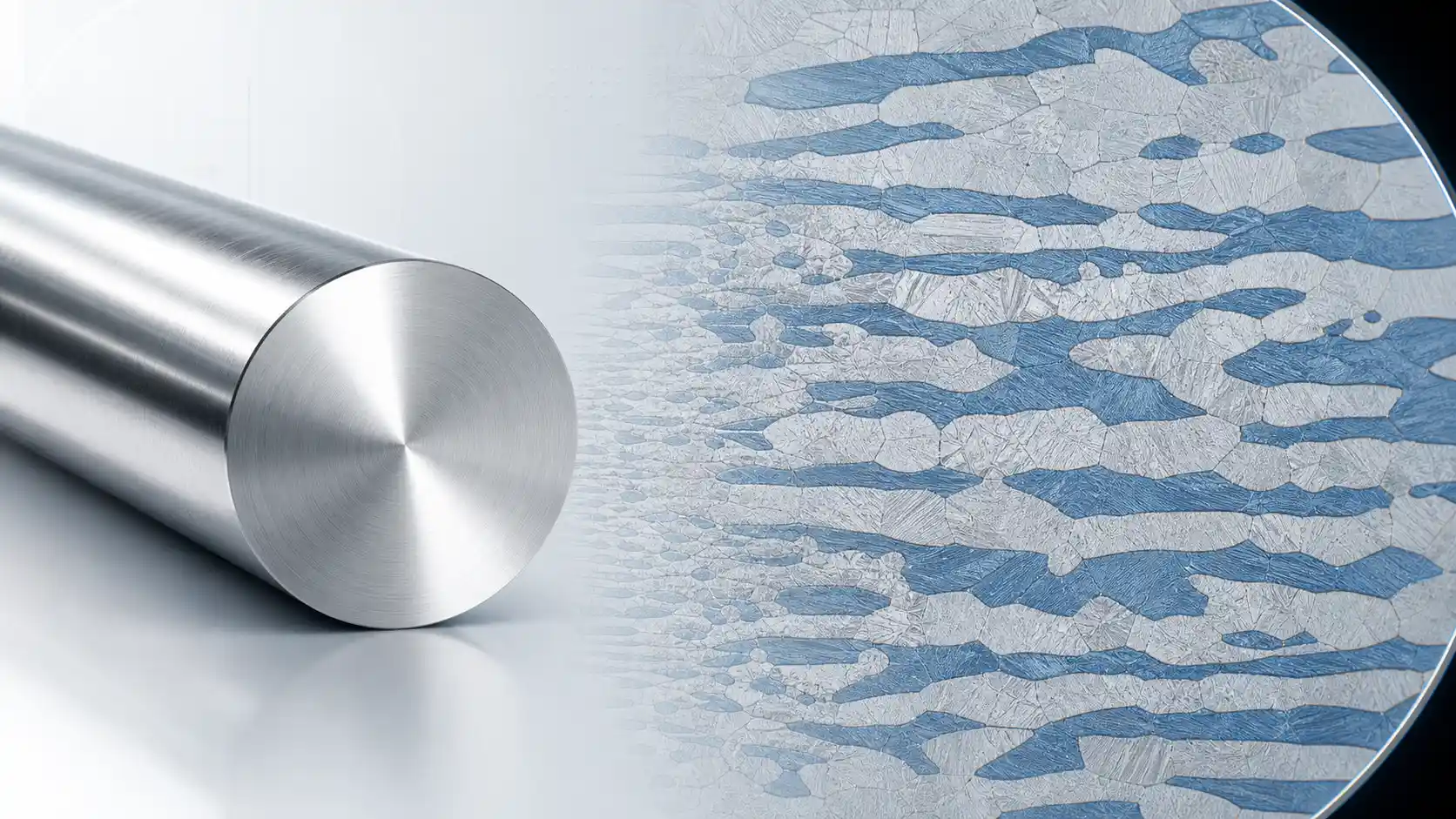
This does not mean duplex is a magic upgrade for every job. It needs correct grade selection, correct heat treatment condition, careful welding control and clean documentation. A good duplex order should be reviewed as a project material, not as a casual commodity grade.
Why Duplex Has Both Strength and Corrosion Resistance
Duplex grades are usually selected because the buyer wants more than one benefit at the same time.
First, duplex stainless steel often offers higher yield strength than 304 or 316L. In some designs, that can help reduce thickness or improve load capacity, but the final decision must follow the design code and engineering approval.
Second, duplex stainless steel has stronger resistance to chloride stress corrosion cracking than common austenitic grades. This matters in seawater, brine, salt spray, chloride-bearing process fluids, some chemical equipment and hot chloride service.
Third, duplex can improve lifecycle value in selected projects. The unit price may be higher than ordinary grades, but better strength and corrosion resistance can reduce failure risk, maintenance trouble or replacement cost.
The buyer should not ask, "Is duplex always better?" A better question is: "Does this service condition make 304 or 316L risky enough that duplex should be reviewed?"
Duplex Stainless Steel Grade Families
The duplex family includes several grade groups. For sourcing, buyers can think in three practical levels.
| Grade Family | Common Examples | Practical Buyer Meaning |
|---|---|---|
| Lean duplex | 2101, 2304 and similar grades | Lower nickel and molybdenum routes. Often reviewed for cost-sensitive strength and moderate corrosion needs. Availability can vary by product form. |
| Standard duplex | 2205, UNS S31803, UNS S32205, EN 1.4462 | The common workhorse duplex path. Often reviewed for bar and plate in marine, chemical, tank, pump, valve, heat exchanger and pressure equipment work. |
| Super duplex | 2507, UNS S32750, EN 1.4410 | Reviewed for more severe chloride, offshore, desalination and high-corrosion service. More project-controlled and less routine than 2205. |
For most bar and plate sourcing, buyers start by comparing 2205 and 2507. Lean duplex and hyper duplex grades exist, but they should be checked early because product form, stock route and mill availability may be more limited.
Common Grade Names Buyers See
Duplex stainless steel may appear under different naming systems. The purchase order, drawing, MTC and packing labels should speak the same language.
| Buying Name | UNS | EN Number | Common Description |
|---|---|---|---|
| 2205 | S31803 / S32205 | 1.4462 | Standard duplex stainless steel |
| 2507 | S32750 | 1.4410 | Super duplex stainless steel |
| F51 / F60 | Often linked with 2205 routes | Project dependent | Forging or pressure-equipment language may appear in some orders |
| F53 | Often linked with 2507 routes | Project dependent | Super duplex forging or pressure-equipment language may appear in some orders |
The same project may use "2205" in email, "UNS S32205" on the drawing and "ASTM A240" or "ASTM A276" in the standard requirement. That is normal, but it must be aligned before shipment.
2205 vs 2507: Which One Should Buyers Review?
2205 and 2507 are not interchangeable shopping names. They serve different levels of corrosion demand.
| Item | 2205 Duplex Stainless Steel | 2507 Super Duplex Stainless Steel |
|---|---|---|
| Common UNS | S31803 / S32205 | S32750 |
| Common EN number | 1.4462 | 1.4410 |
| Typical role | Standard duplex grade for many industrial projects | Super duplex grade for more severe corrosion exposure |
| Buyer use cases | Pump shafts, valves, tanks, pressure equipment, chemical equipment, seawater systems | Desalination, offshore, high-chloride service, severe chemical environments |
| Sourcing note | More common than 2507, but still needs document review | Review availability, testing scope and lead time early |
| Inspection focus | MTC, heat number, PMI, standard wording | MTC, heat number, PMI, corrosion testing or third-party inspection when required |
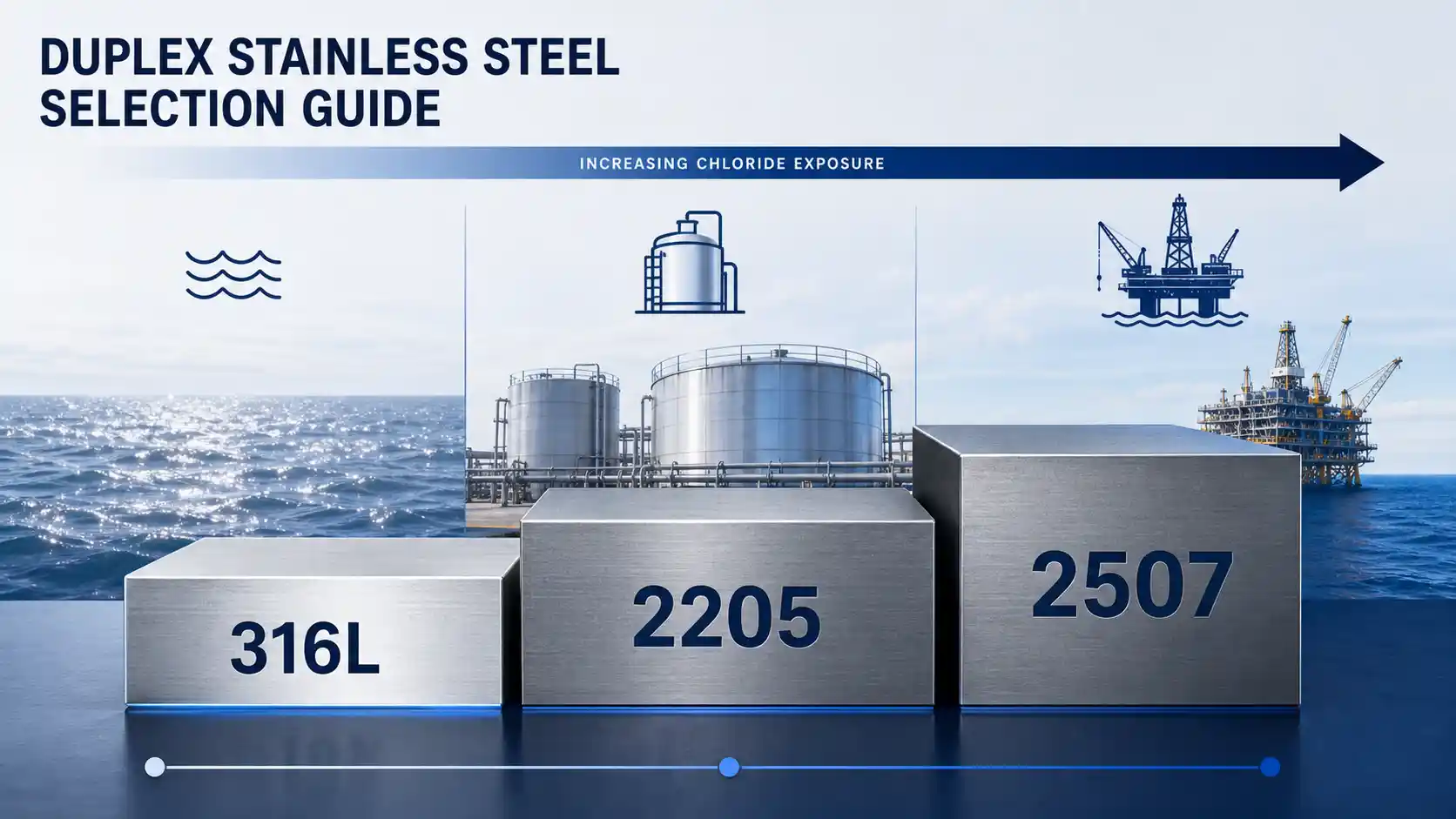
A buyer can think of 2205 as the first serious duplex review route. 2507 is not simply a better 2205. It is a stronger choice for harsher conditions, and it normally needs more careful document and availability review.
Duplex vs 316L: The Practical Upgrade Question
316L is still a useful grade. It is widely available, easy to source in many product forms and suitable for many general corrosion environments. Duplex should not replace 316L just because the word sounds stronger.
Duplex becomes worth reviewing when one or more of these points appears:
- chloride exposure is high or continuous
- pitting, crevice corrosion or stress corrosion cracking is a known risk
- the design needs higher yield strength
- the part is difficult to maintain or replace
- the project has a long service-life requirement
- welding, inspection and MTC requirements are already tightly controlled
For low-risk indoor equipment, 316L may be enough. For stronger chloride exposure, 2205 is often reviewed. For severe chloride, offshore, desalination or aggressive chemical service, 2507 may enter the discussion.
PREN: Useful, But Not the Only Decision Tool
PREN means Pitting Resistance Equivalent Number. It is a calculated reference used to compare resistance to localized pitting corrosion. A common formula is:
PREN = Cr + 3.3 x Mo + 16 x N
Some formulas also include tungsten. The point is not to use PREN as the only design tool. The point is to understand why chromium, molybdenum and nitrogen matter so much in duplex stainless steel.
2205 usually has a higher PREN than 316L. 2507 is higher again. That is why buyers often review 2507 for severe chloride service. But PREN does not replace real project checks. Temperature, crevices, surface finish, welding, cleaning practice, actual fluid chemistry and inspection requirements still matter.
Common Product Forms: Bar, Plate, Pipe and Fittings
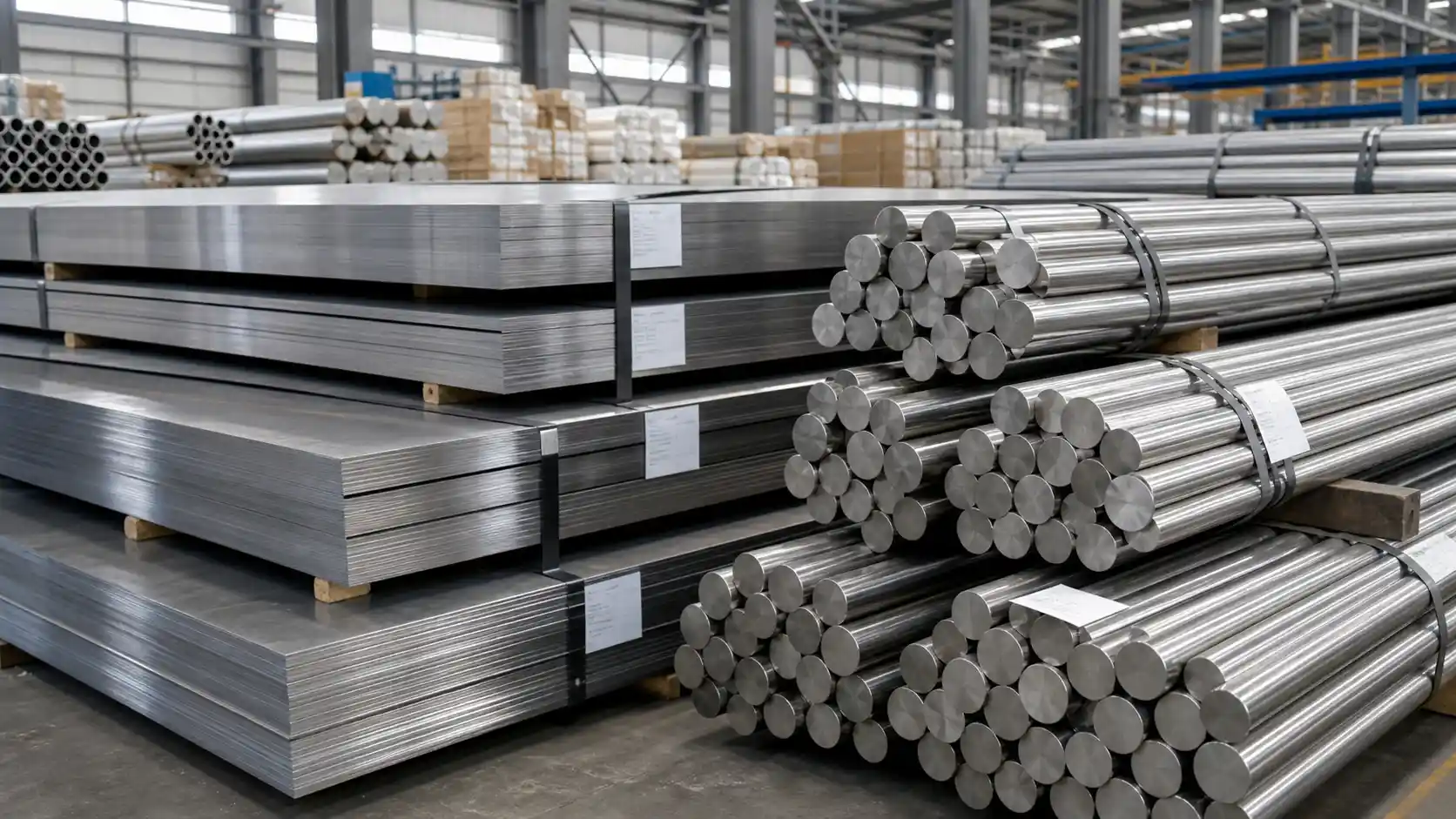
Duplex stainless steel is used in several product forms. On the sourcing side, bar and plate are two of the most common forms buyers review early.
| Product Form | Common Buyer Questions |
|---|---|
| Bar | Is it round bar, forged bar, peeled bar or machined blank? What diameter, tolerance, surface and standard are required? |
| Plate | What thickness, width, length, surface, cutting plan and plate standard are required? |
| Pipe | Is welded or seamless pipe required? What pressure, wall thickness and project standard apply? |
| Fittings and flanges | Which pressure class, forging route, standard and testing scope are required? |
FX Stainless Steel currently focuses duplex product support on bar and plate pages. Pipe, fittings and flanges may still appear in project documents, so buyers should keep the whole material package in mind when checking grade and certificate consistency.
Duplex Stainless Steel Bar: Buyer Notes
Duplex stainless steel bar is usually reviewed for machined or loaded parts that need both corrosion resistance and strength.
Common cases include:
- pump shafts and valve stems
- fasteners and threaded parts
- marine hardware
- chemical equipment parts
- desalination components
- high-strength machined blanks
For bar orders, the buyer should confirm the exact product form. A hot rolled round bar, forged bar, peeled bar and finished shaft blank are not the same supply route. Diameter, length, surface, tolerance, cutting plan and testing scope should be stated before quotation.
If you are sourcing bar stock, start with our duplex stainless steel bar page. For theoretical weight, use the stainless steel bar weight calculator and select the 2205 or 2507 density option.
Duplex Stainless Steel Plate: Buyer Notes
Duplex stainless steel plate is usually reviewed for flat-product projects where strength, corrosion resistance and document control matter together.
Common cases include:
- tanks and pressure equipment
- heat exchangers
- seawater and brine systems
- chemical processing equipment
- desalination projects
- structural or fabricated parts exposed to chloride service
For plate orders, the buyer should confirm thickness, width, length, surface condition, cutting requirement and standard wording. ASTM A240 is commonly used for stainless steel plate, sheet and strip, while EN 10088-2 may appear in European project documents.
If your project needs plate, review our duplex stainless steel plate page. For quick mass estimation, use the stainless steel plate weight calculator.
Chemical Composition and Standard Names
Duplex grade selection should be tied to the standard and UNS number, not only to a short trade name.
For bar, buyers often see ASTM A276, ASTM A479 or EN 10088-3. For plate, buyers often see ASTM A240 or EN 10088-2. The exact standard should follow the purchase order, drawing, end-user specification or project code.
In MTC review, pay attention to chromium, molybdenum, nickel and nitrogen. These elements influence corrosion resistance, strength and grade identity. If the project requires PMI, the PMI method and acceptance wording should be agreed before shipment.
Mechanical Properties and Strength Advantage
One reason duplex stainless steel attracts engineers is strength. Duplex grades commonly provide higher yield strength than 304 or 316L. In some cases, that can support lighter designs or stronger parts.
But strength is not enough by itself. A buyer should also check elongation, impact testing if required, hardness limit, product condition and the standard named in the order. For pressure equipment or structural work, the design code and project engineer control the final acceptance.
This is why a duplex quote should not be judged only by price per kilogram. The real comparison includes strength, corrosion risk, testing scope, document control, cutting plan and delivery route.
Corrosion Resistance: What Duplex Is Good At
Duplex stainless steel is often selected for resistance to:
- chloride stress corrosion cracking
- pitting corrosion
- crevice corrosion
- seawater and brine exposure
- selected chemical processing environments
That does not mean every duplex grade can survive every corrosive environment. Temperature, concentration, oxygen level, crevice design, welding condition and cleaning practice all matter. For severe projects, corrosion testing or third-party review may be required.
If the buyer already knows the service fluid, temperature and cleaning procedure, include that information in the inquiry. It helps the supplier and end user review whether 2205, 2507, 316L or another route is more suitable.
Fabrication and Welding Notes
Duplex stainless steel can be welded and fabricated, but it should not be treated exactly like 304 or 316L.
The key issue is phase balance. Welding, excessive heat, slow cooling, contamination and poor cleaning can affect corrosion performance. For project work, the welding procedure, filler metal, heat input, interpass temperature, shielding gas and post-weld cleaning should follow the approved WPS and project specification.
A practical buyer does not need to solve the welding procedure in the inquiry email. But the buyer should tell the supplier if the material will be welded, if impact testing is needed, if corrosion testing is required, or if the project has a third-party inspection plan.
Machining Duplex Stainless Steel
Duplex stainless steel can be machined, but it is not as forgiving as ordinary free-cutting material. The higher strength and work-hardening behavior can increase tool pressure.
For machined bar parts, buyers should tell the supplier whether the material will be used for shafts, valve parts, threaded parts, fasteners or finished blanks. Surface condition, diameter tolerance, straightness and machining allowance can affect the real production route.
Machining teams usually prefer sharp tools, stable setup, suitable coolant and conservative parameters compared with softer or more free-machining stainless grades. If the part is sensitive, discuss test pieces or sample support before the main order.
Heat Treatment and Surface Condition
Duplex stainless steel should normally be supplied in the correct solution-annealed condition required by the grade and standard. Poor heat treatment can damage corrosion performance and mechanical reliability.
Surface condition also matters. Plate may be supplied with No.1 hot rolled surface, pickled surface or cut edges. Bar may be hot rolled, forged, peeled, turned, ground or cut to length. The surface route affects machining, welding preparation, inspection and packing.
If the order needs special surface control, the buyer should say so before quotation. "Duplex plate" is not enough. "2205 plate, ASTM A240, 12 mm, No.1 surface, cut-to-size, MTC and PMI required" is much clearer.
MTC, PMI and Third-Party Inspection Checklist
For duplex stainless steel, the MTC is not a formality. It is part of the purchase decision.
Before shipment, buyers should review:
| Document Item | Why It Matters |
|---|---|
| Grade and UNS number | Confirms whether the supply is 2205, S31803, S32205, 2507 or S32750 |
| Standard wording | Should match ASTM A276, ASTM A479, ASTM A240, EN requirement or project specification |
| Heat number | Connects the certificate to labels, packing and actual batch |
| Chemical composition | Helps confirm Cr, Mo, Ni and N levels for the grade family |
| Mechanical properties | Important for high-strength design requirements |
| PMI or third-party inspection | Useful when the project requires extra confirmation before release |
| Packing labels and documents | Invoice, packing list, labels and MTC should not conflict |
If the buyer only asks for duplex steel without a UNS number or standard, the supplier may not know what document route is acceptable. A clearer inquiry saves time.
How to Write a Clear Duplex Inquiry
Weak inquiry:
Need duplex stainless steel bar and plate. Please quote.
Better bar inquiry:
Please review 2205 duplex stainless steel round bar, UNS S32205, ASTM A276, diameter 35 mm, peeled surface, 3 m length, MTC and PMI required, destination port to confirm.
Better plate inquiry:
Please review 2205 duplex stainless steel plate, ASTM A240, thickness 12 mm, 1500 x 6000 mm, No.1 surface, MTC required, cut-to-size review, destination port to confirm.
This wording gives the supplier enough information to check grade, product form, standard, stock route, cutting, documents and export packing before quotation.
How FX Stainless Steel Reviews Duplex Requirements
When FX Stainless Steel receives a duplex bar or plate inquiry, we first keep the buyer's original wording visible. We do not reduce everything to a single grade name too early.
Our review usually covers:
- grade path: 2205, UNS S31803, UNS S32205, 2507 or UNS S32750
- product form: bar, round bar, forged bar, plate, cut piece or fabricated blank
- standard: ASTM A276, ASTM A479, ASTM A240, EN 10088 or project specification
- size: diameter, thickness, width, length and cutting plan
- surface and finish requirement
- MTC, heat number, PMI and third-party inspection requirement
- export packing, labels, invoice and packing list wording
- destination port and document requirement
If current stock does not match the exact wording, availability and alternative routes can be reviewed. The important point is to confirm documents before shipment, not after the cargo arrives.
Authoritative References
Authoritative references for this topic include the IMOA duplex stainless steel overview, ASTM A276/A276M stainless steel bars and shapes, ASTM A240/A240M stainless steel plate, sheet and strip, NBN EN 10088-3 stainless steel bars, rods, wire and sections and NBN EN 10088-2 stainless steel sheet, plate and strip.
Always follow the latest edition named by the buyer, drawing, purchase order, end-user specification or project code.
Conclusion
Duplex stainless steel is worth reviewing when 304 or 316L may not provide enough strength, chloride resistance or lifecycle margin. For many buyers, 2205 is the first duplex route to check. 2507 should be reviewed when the chloride or corrosion condition is more severe.
The right order is not only about choosing a grade name. For duplex bar and plate, buyers should confirm UNS number, product form, standard, size, finish, MTC, heat number, testing requirement and export documents before shipment.
Frequently Asked Questions (FAQ)
Q. What is duplex stainless steel?
A. Duplex stainless steel is a stainless steel family with both austenite and ferrite in its structure. It is usually reviewed when buyers need higher strength and stronger chloride stress corrosion cracking resistance than common 304 or 316L stainless steel.
Q. Is duplex stainless steel better than 316L?
A. Not automatically. Duplex grades such as 2205 are often reviewed when 316L may not provide enough strength or chloride resistance, but 316L can still be a practical choice for many less severe applications.
Q. What is the difference between 2205 and 2507?
A. 2205 is the common standard duplex grade. 2507 is a super duplex grade for more severe chloride, offshore, desalination and high-corrosion service. 2507 usually needs earlier availability and inspection review.
Q. What does PREN mean in duplex stainless steel?
A. PREN means Pitting Resistance Equivalent Number. It is a calculated reference used to compare pitting resistance, but it does not replace service-environment review, welding control, surface condition and project testing requirements.
Q. Can duplex stainless steel be welded?
A. Yes, but welding should follow a qualified procedure. Heat input, interpass temperature, filler metal, shielding gas, cleaning and post-weld inspection can all affect performance.
Q. Is duplex stainless steel difficult to machine?
A. Duplex stainless steel can be machined, but it is stronger than common austenitic grades. Buyers should allow for proper tooling, stable coolant, realistic cutting parameters and suitable machining allowance.
Q. What documents should buyers check for duplex stainless steel?
A. Buyers should check grade, UNS number, standard wording, heat number, chemical composition, mechanical properties, MTC, PMI requirement, third-party inspection scope and packing label consistency.
Q. What should I send for a duplex stainless steel quote?
A. Send grade or UNS number, product form, size, standard, surface, quantity, application, destination port, MTC requirement and any PMI, third-party inspection or project testing requirement.
CTA
If you are reviewing duplex stainless steel for marine, chemical, desalination, pressure equipment or high-chloride service, send FX Stainless Steel your grade, UNS number, product form, size, quantity, standard, MTC requirement and destination port. We can help review whether duplex stainless steel bar, duplex stainless steel plate, 316L or another supply route is more practical before quotation.