
304 vs 304L Stainless Steel Bar: When Does 304L Really Matter?
304L is useful for some bar orders, but not all of them. Compare 304 vs 304L stainless steel bar for welding, MTC review and real buying decisions.
In This Guide
- Introduction
- Quick Answer
- Why 304 and 304L Are Often Confused in Bar Buying
- 304 vs 304L Stainless Steel Bar Comparison
- When 304 Is Already Enough for Bar Buyers
- When 304L Really Matters
- What Does 304/304L Dual Certified Mean for Bar Buyers?
- What to Check on the MTC Before Ordering
- Southeast Asia Buyer Note
- What We Usually Check Before Quotation
- Practical Buyer Checklist
Introduction
When buyers compare 304 vs 304L stainless steel bar, they are usually not looking for a textbook answer. They want to know one thing: does the low-carbon grade matter for this order, or is 304 already enough?
With bar orders, carbon is only part of the story. Welding matters. The drawing matters. The MTC matters. So does the bar form, whether it is round, hex or square.
Quick Answer
Choose 304 stainless steel bar when you need a general-purpose grade and the drawing does not call for low carbon. Choose 304L stainless steel bar when welding, fabrication review or project wording makes low carbon important.
If the part is a non-welded shaft, pin or simple machined part, 304L is not automatically the better buy. In many orders, size, finish, tolerance and document match matter more than paying for a grade the job does not need.
Why 304 and 304L Are Often Confused in Bar Buying
On paper, the two grades look very close. Both are common austenitic stainless steels. Both are widely used where general corrosion resistance is needed. The main difference is carbon.
304 allows a higher carbon limit. 304L uses a lower-carbon route. That lower carbon helps reduce sensitization risk after welding, so 304L often comes up in welded parts and fabrication work.
Where buyers get into trouble is the next step. They see “lower carbon” and read it as “better in every case.” For bar buying, that is too simple. A non-welded round bar for pins is not the same as a bar that will be machined and then welded into an assembly.
304 vs 304L Stainless Steel Bar Comparison
| Buyer Check | 304 Stainless Steel Bar | 304L Stainless Steel Bar | What It Means for Buyers |
|---|---|---|---|
| Main difference | Standard carbon route | Lower-carbon route | 304L matters most when welding or project wording requires it |
| Carbon reference | Max 0.08% | Max 0.03% | Lower carbon helps reduce weld-related sensitization risk |
| Common bar use | General shafts, pins, fittings, supports | Similar uses when low carbon is requested | Shape and application still need review |
| Welding review | Possible, but confirm project need | Often preferred when welding matters | Do not choose by grade name alone |
| Typical buyer mistake | Assuming 304 is always too basic | Assuming 304L is always worth the upgrade | Start from the drawing and actual use |
When 304 Is Already Enough for Bar Buyers
304 is often enough for general industrial parts, stock replenishment, supports, pins, shafts and non-welded machined parts. In those jobs, the buyer may get more value from checking diameter, cut length, finish and tolerance than from moving to 304L without a clear reason.
Take a few simple examples. A round bar still needs the right size and finish before machining. A hex bar still needs the correct across-flats size. A cut-to-length order still needs the right length and packing plan. Changing the grade to 304L does not solve any of those problems.
If machining performance is the bigger question, our 303 vs 304 stainless steel bar guide explains when machinability matters more than the 304 vs 304L choice.
When 304L Really Matters
304L matters more when the bar will be welded, when the drawing clearly calls for 304L, or when the project wants a lower-carbon grade for fabrication review. In those cases, the difference is practical, not academic.
Ask these three questions early:
- Will the bar be welded directly or machined into a welded part?
- Does the drawing or purchase order name 304L?
- Does the end user expect low-carbon material on the final MTC?
If the answer is yes, 304L deserves a proper review. If the answer is no, there may be no reason to pay extra for it.
What Does 304/304L Dual Certified Mean for Bar Buyers?
Sometimes a supplier may call a batch 304/304L dual certified. In simple terms, that means the batch is documented as meeting both grade routes.
That can be useful when the project accepts either wording. But it does not mean every 304 bar in stock is dual certified. The better question is not, "Do you sell dual certified material?" It is, "Does this batch and this MTC meet the standard and project requirement I need?"
In other words, check the document. Do not let the phrase replace the check.
What to Check on the MTC Before Ordering
When comparing 304 vs 304L stainless steel bar, do not stop at the sales label. The Mill Test Certificate should support the order.
Before release, check:
- grade wording: 304, 304L or dual-certified wording when applicable
- carbon value
- heat number
- standard reference
- bar form and size description
- match between the MTC, labels and ordered material
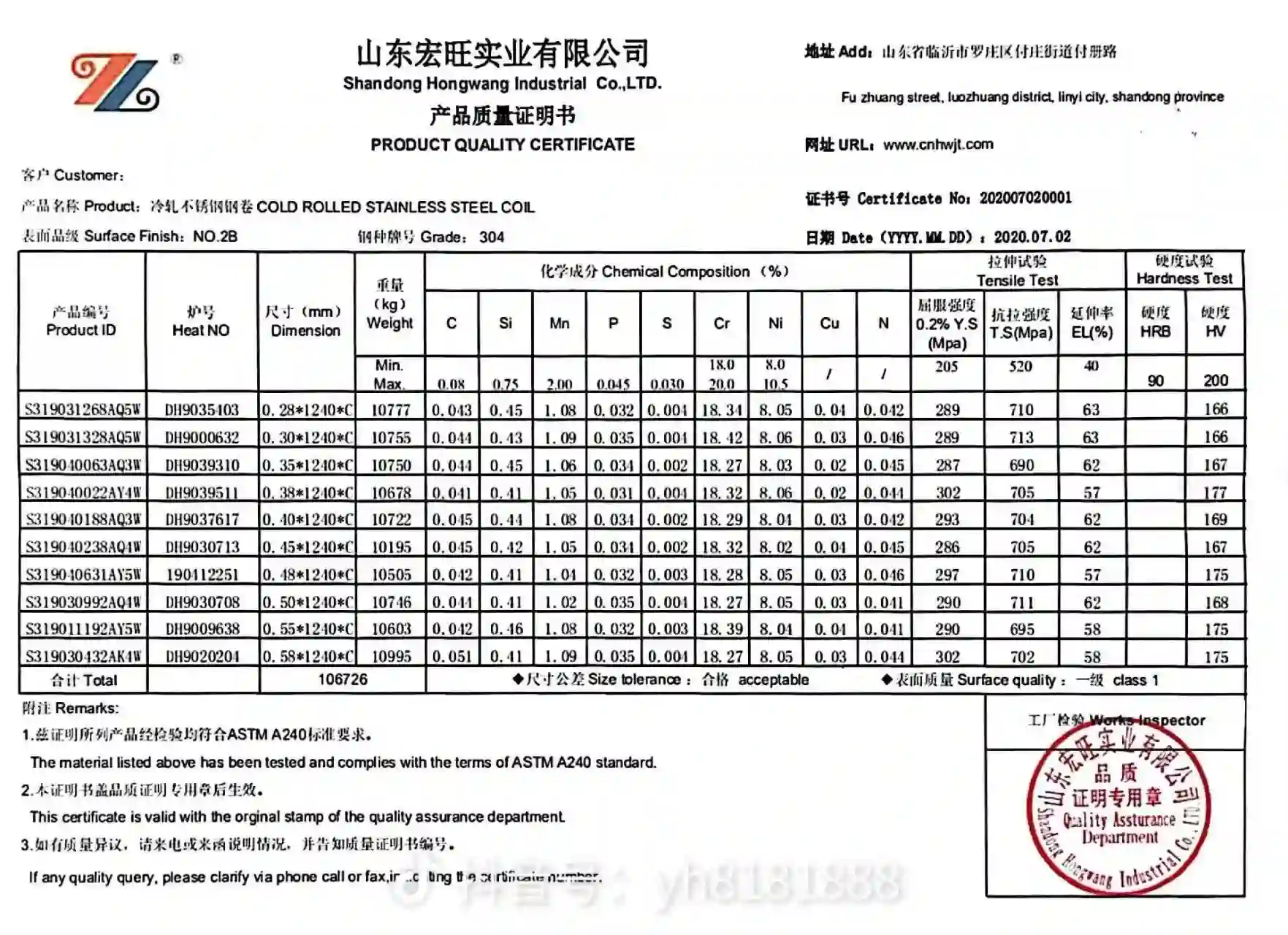
If the certificate is still unclear, read our stainless steel MTC guide before approving the shipment.
Southeast Asia Buyer Note
Many buyers in Southeast Asia, especially Japanese-invested factories, still use names such as SUS304 and SUS304L in drawings, packing lists and internal approvals. That is common. It is still worth checking that the wording matches the PO and the MTC.
If one document says SUS304L and another only says 304, pause before quotation or release. The buyer may need a naming match, a low-carbon grade, or both.
For cross-standard naming checks, use our stainless steel grade equivalent lookup.
What We Usually Check Before Quotation
Before quoting a 304 or 304L bar order, we usually check:
- grade wording: 304, 304L, SUS304 or SUS304L
- bar shape: round, hex or square
- size and tolerance
- finish: cold drawn, polished, bright or ground
- whether welding is involved
- whether the project names a specific standard
- MTC and heat-number requirement
- quantity, cut length and destination
This is why “304L price” is not enough for a useful inquiry. The right buying path comes from the full specification, not from one line in the grade column.
Practical Buyer Checklist
| Before You Confirm | Why It Matters |
|---|---|
| Read the drawing first | It tells you whether 304L is actually required |
| Ask whether welding is involved | This is where the low-carbon route matters most |
| Match the MTC to the ordered grade | It helps prevent document drift between 304 and 304L |
| Confirm shape, size and finish | Bar buying is not only a chemistry decision |
| Review nearby alternatives | 303 may machine better; 316/316L may suit chloride exposure better |
If corrosion exposure is the main issue instead of welding, compare the grade path in our 304 vs 316 coastal projects guide.
Conclusion
The difference between 304 and 304L matters, but not in every bar order. 304 is often the practical choice for general non-welded bar use. 304L becomes important when welding, low-carbon wording or project documents make it necessary.
A good buying decision starts with the drawing, the application and the MTC. The more specialized grade is not always the better one.
Frequently Asked Questions (FAQ)
Q. Is 304L always better than 304 stainless steel bar?
A. No. If the part will not be welded and the drawing does not ask for low carbon, 304 is often enough. 304L is more useful when welding or project wording calls for it.
Q. When should a buyer choose 304L stainless steel bar instead of 304?
A. Choose 304L stainless steel bar when the part will be welded, when the drawing names 304L, or when the end user wants the lower-carbon route shown on the final documents.
Q. What does 304/304L dual certified mean?
A. It means that specific batch is documented as meeting both 304 and 304L requirements. Do not assume every batch does. Check the actual MTC before ordering.
Q. What should I check on the MTC for 304 vs 304L bar?
A. Start with the grade wording and carbon value. Then check the heat number, standard reference and whether the certificate matches the actual bar form, size and batch.
Q. Are SUS304 and SUS304L the same as 304 and 304L?
A. SUS304 and SUS304L are common JIS names that many buyers use for the same grade families. Final acceptance should still follow the drawing, PO and MTC.
CTA
Send the grade wording, bar shape, size, finish, tolerance, quantity and application to FX Stainless Steel. We can help review whether 304 stainless steel bar or 304 stainless steel round bar is the practical fit before quotation.